Best Thai Street Food: 10 Dishes and Ordering Tips
Try 10 popular Thai street food dishes, learn what to say when ordering, manage spice, and use every meal as practical Thai language practice.
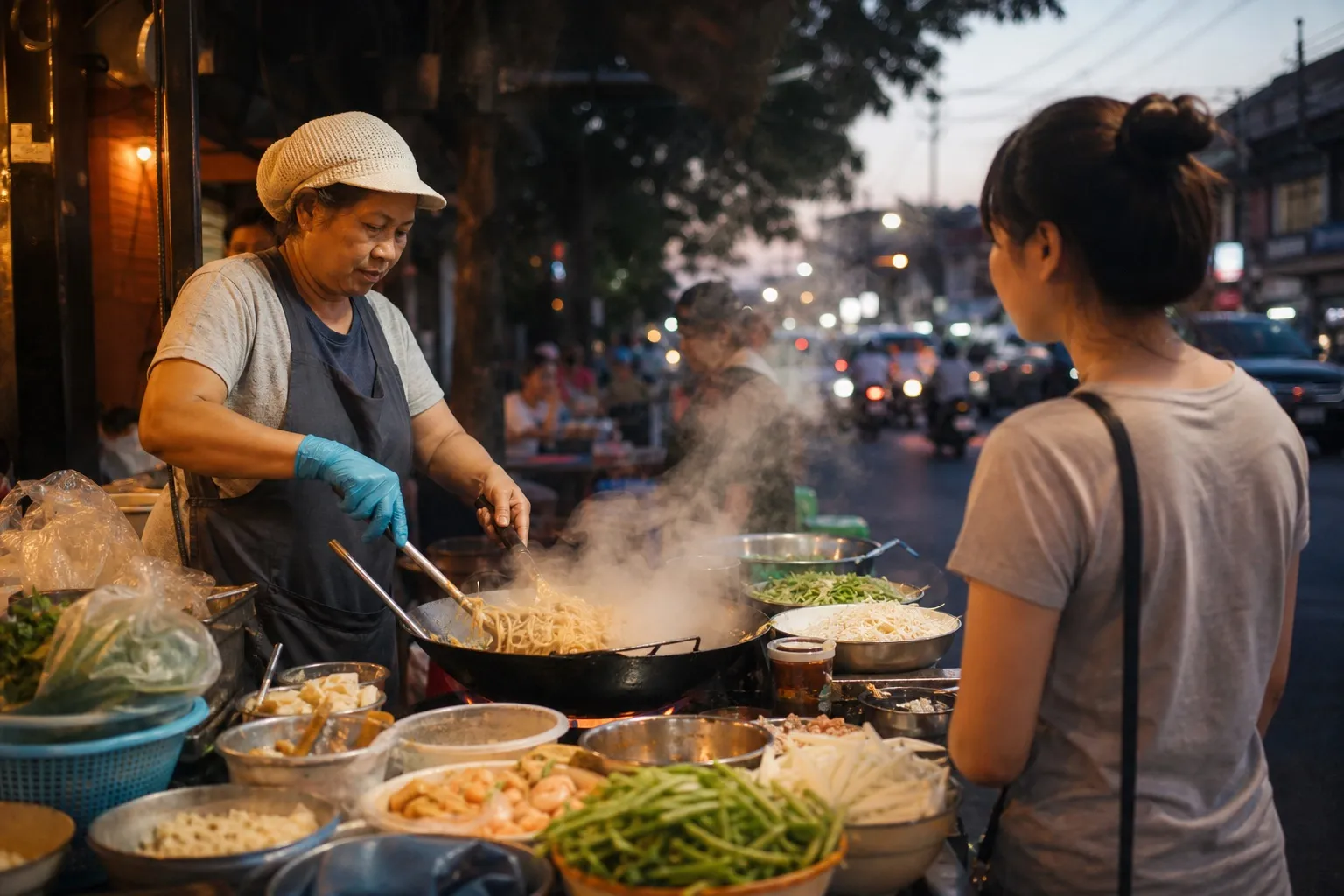
Thai street food is one of the fastest ways to understand how Thai people actually speak, eat, and live. For a foreigner learning Thai, a street food stall is not just a place to eat. It is a free classroom where you can practice tones, numbers, classifiers, polite particles, and real listening skills with patient vendors who often repeat themselves naturally. This guide covers 10 common dishes, the language you need to order them, how to manage spice, and how to stay safe while eating on the street. It does not recommend a single best vendor or give current prices, because those change constantly and depend on the neighborhood.
Why Street Food Helps Thai Learners
Street food vendors speak fast, use short sentences, and rely on context. That makes them good practice partners for intermediate learners. A vendor might say “เอาเผ็ดไหม” (ao phet mai), meaning “Do you want it spicy?” You do not need to understand every word if you recognize “เผ็ด” (phet, spicy) and the question particle “ไหม” (mai). Over time, these small exchanges build listening speed.
There is also a cultural benefit. Thai street food is ordered in a specific sequence. You choose a dish, state how you want it, say whether you will eat there or take away, and pay. Learning this sequence helps you sound less like a tourist reading from a phrasebook and more like someone who understands how the interaction works.
How to Order Without Freezing
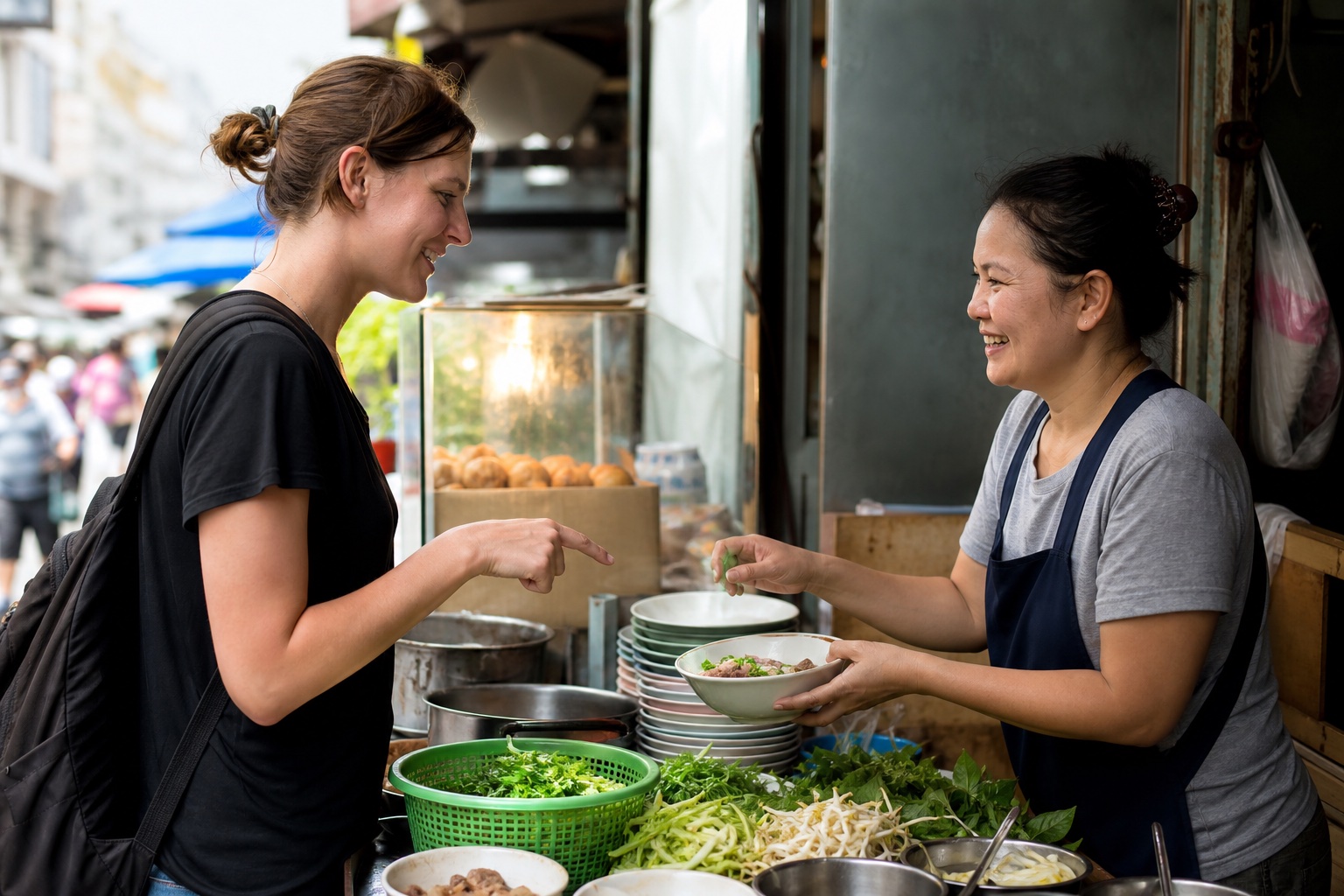
Start with the dish name. Then add one or two modifiers. Then say where you will eat. For example:
“ผัดไทยค่ะ ไม่เผ็ด เอากลับบ้าน” (phat thai kha, mai phet, ao klap ban) “Pad Thai, not spicy, take away.”
The word “ค่ะ” (kha) is commonly used by women for ordinary statements, while “คะ” (kha) is commonly used in many questions. Men use “ครับ” (khrap). If you are not sure which to use, listen to the vendor or other customers. The particle goes at the end of a phrase or sentence.
If you cannot say the full sentence, you can point and say “อันนี้” (an ni, this one) or “เอา” (ao, I want). Vendors are used to short orders. A smile and a clear attempt at Thai usually works better than a long English explanation.
Spice Level and How to Control It
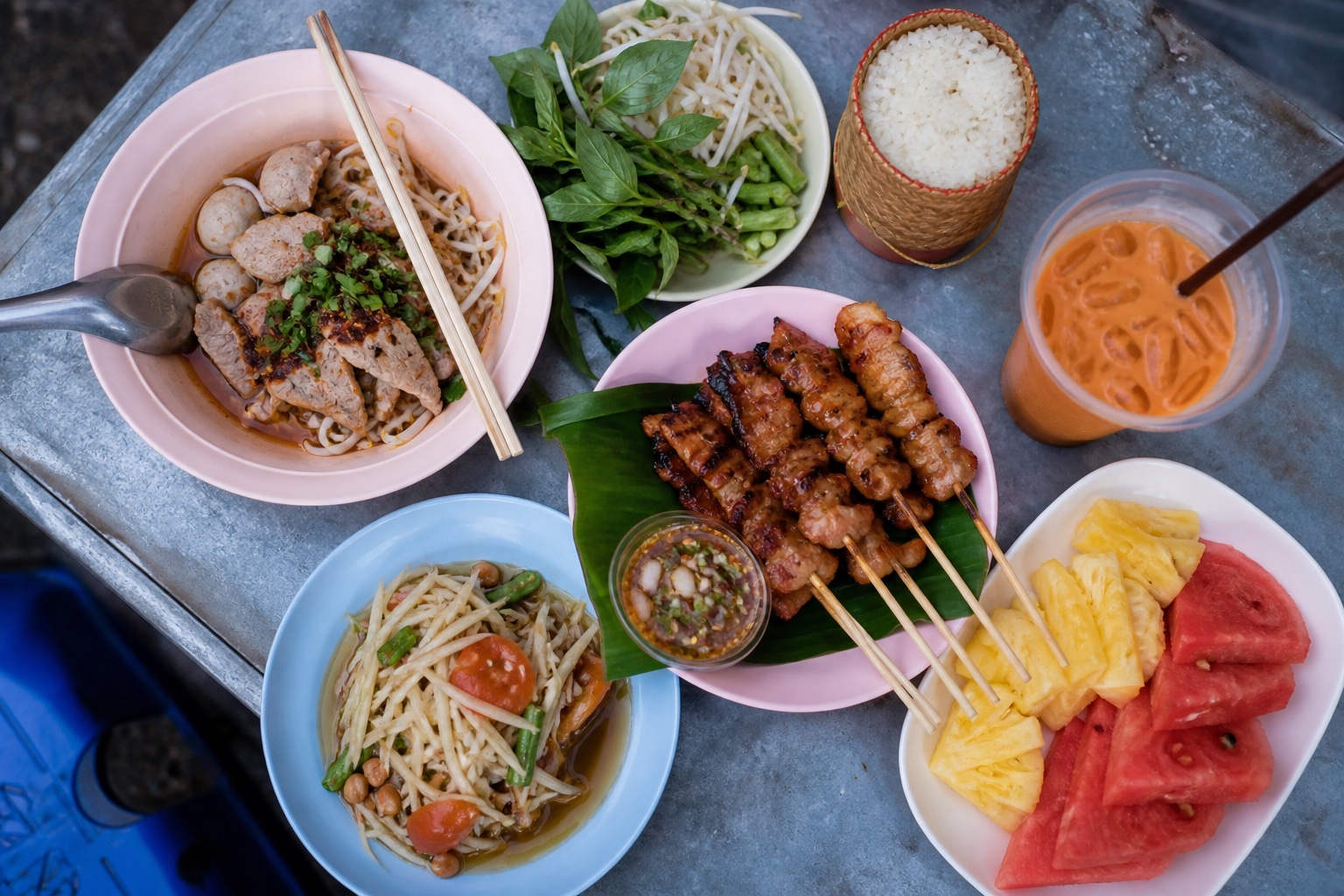
Spice in Thai food is not a single scale. Some dishes are made spicy in the cooking process. Others are served mild with chili on the side. If you want to avoid spice, the safest phrase is “ไม่เผ็ด” (mai phet, not spicy). If you want a little spice, say “เผ็ดน้อย” (phet noi, a little spicy). If you want the normal level, say “เผ็ดปกติ” (phet pokati, normal spice).
Be careful with “เผ็ดน้อย” (phet noi) at stalls that serve northeastern Thai food. A vendor’s idea of “a little spicy” can still be very hot. If you are new to Thai food, start with “ไม่เผ็ด” (mai phet) and add chili yourself from the condiment tray.
The condiment tray usually has four things: dried chili flakes (พริกป่น, phrik pon), fish sauce with chilies (น้ำปลาพริก, nam pla phrik), sugar (น้ำตาล, nam tan), and vinegar with chilies (น้ำส้มพริก, nam som phrik). You can adjust your own plate without asking the vendor to remake the dish.
Food Safety Basics
Street food in Bangkok is generally safe when you follow a few rules. Choose stalls with a high turnover of customers. Food that sits for hours is more likely to cause problems. Watch whether the vendor uses gloves or tongs, but do not expect gloves everywhere. Many vendors handle money and food with the same hands, which is common and not automatically dangerous.
Drink bottled water or other sealed drinks. Avoid ice if you are not sure of the source, although most ice in Bangkok comes from commercial ice factories and is safe. If a stall looks clean and busy, it is probably fine. If you have a sensitive stomach, start with cooked dishes rather than raw papaya salad or fresh spring rolls.
10 Thai Street Food Dishes Worth Knowing
1. ผัดไทย (Phat Thai, Pad Thai)
Pad Thai is the most famous Thai noodle dish outside Thailand. It is stir-fried rice noodles with egg, tofu, dried shrimp, bean sprouts, and a sauce made from tamarind, fish sauce, and palm sugar. It often comes with a wedge of lime and crushed peanuts.
For a Thai learner, Pad Thai is useful because the name is easy to say and widely understood. You can practice the falling tone on “ผัด” (phat). If you say it with a rising tone, it can sound like a different word. Vendors will usually understand from context, but the tone practice is valuable.
Ordering phrase: “ผัดไทยไม่เผ็ด เอากลับบ้าน” (phat thai mai phet, ao klap ban).
2. ส้มตำ (Som Tam, Green Papaya Salad)
Som tam is a salad made from shredded unripe papaya, tomatoes, long beans, peanuts, dried shrimp, lime juice, fish sauce, and chilies. It is a northeastern Thai dish, and the standard version is spicy. You can ask for “ไม่เผ็ด” (mai phet) but be aware that the chili is often pounded into the salad, so the vendor may need to make a fresh portion without chilies.
There are several variations. “ส้มตำไทย” (som tam thai) is the central Thai version, often sweeter and less spicy. “ส้มตำปู” (som tam pu) includes fermented crab. “ส้มตำปลาร้า” (som tam pla ra) includes fermented fish sauce, which has a strong smell and taste.
Som tam is good language practice because you can ask for “ไม่ใส่ปู” (mai sai pu, without crab) or “ไม่ใส่ปลาร้า” (mai sai pla ra, without fermented fish). The verb “ใส่” (sai, to put in) is one of the most useful words in Thai food ordering.
3. ก๋วยเตี๋ยว (Kuai Tiao, Noodle Soup)
Kuai tiao is a broad category of noodle soups. You choose the noodle type, the meat, and the broth. Common noodle types are “เส้นเล็ก” (sen lek, thin rice noodles), “เส้นใหญ่” (sen yai, wide rice noodles), “บะหมี่” (ba mi, egg noodles), and “วุ้นเส้น” (wun sen, glass noodles). Common meats are “หมู” (mu, pork), “ไก่” (kai, chicken), and “เนื้อ” (nuea, beef).
This dish is excellent for practicing classifiers and modifiers. You can say “ก๋วยเตี๋ยวเส้นเล็กหมูน้ำใส” (kuai tiao sen lek mu nam sai), which means thin rice noodle soup with pork in clear broth. “น้ำใส” (nam sai) is clear broth. “น้ำตก” (nam tok) is a richer broth with a darker color.
If you want dry noodles without soup, say “แห้ง” (haeng). If you want soup, say “น้ำ” (nam). The word “น้ำ” (nam) also means water, so context matters.
4. ข้าวมันไก่ (Khao Man Kai, Chicken Rice)
Khao man kai is poached chicken served over rice cooked in chicken fat and stock. It comes with a bowl of clear soup and a dipping sauce made from fermented soybean paste, ginger, garlic, and chilies. The dish is mild by default, which makes it a safe choice for beginners.
The name is a good lesson in Thai word order. “ข้าว” (khao) means rice, “มัน” (man) means oil or fat, and “ไก่” (kai) means chicken. So the literal meaning is “rice oil chicken” or “chicken fat rice.” Thai puts the main noun first and modifiers after, which is the opposite of English.
You can practice asking for “ข้าวมันไก่ต้ม” (khao man kai tom) for boiled chicken or “ข้าวมันไก่ทอด” (khao man kai thot) for fried chicken. The word “ทอด” (thot) means deep-fried.
5. ข้าวผัด (Khao Phat, Fried Rice)
Khao phat is fried rice, usually with egg, onion, and a protein. Common versions are “ข้าวผัดหมู” (khao phat mu, pork fried rice), “ข้าวผัดไก่” (khao phat kai, chicken fried rice), and “ข้าวผัดกุ้ง” (khao phat kung, shrimp fried rice).
This is one of the easiest dishes to order because the pattern is simple. “ข้าวผัด” (khao phat) plus the protein. You can also add “ไข่ดาว” (khai dao, fried egg) or “ไข่เจียว” (khai jiao, Thai omelet). Thai fried rice is often served with cucumber slices and a wedge of lime.
For language practice, try ordering without onion: “ไม่ใส่หอม” (mai sai hom). The word “หอม” (hom) means onion or shallot. This is a useful phrase if you have food restrictions.
6. ต้มยำกุ้ง (Tom Yum Kung, Spicy Shrimp Soup)
Tom yum kung is a hot and sour soup with shrimp, lemongrass, galangal, kaffir lime leaves, chilies, and lime juice. The name breaks down as “ต้ม” (tom, boiled), “ยำ” (yum, mixed salad), and “กุ้ง” (kung, shrimp). It is one of the most internationally known Thai dishes.
There are two main versions. “น้ำใส” (nam sai) is a clear broth. “น้ำข้น” (nam khon) is a creamier version with evaporated milk or coconut milk. The creamy version is often less spicy, but not always.
Tom yum is a good dish for learning the names of Thai herbs. “ตะไคร้” (takhrai) is lemongrass. “ข่า” (kha) is galangal. “ใบมะกรูด” (bai makrut) is kaffir lime leaf. You do not eat these herbs. They are for flavor. If you try to chew them, you will have a difficult time.
7. ผัดกะเพรา (Phat Kaphrao, Holy Basil Stir-Fry)
Phat kaphrao is a stir-fry of meat with holy basil, garlic, chilies, and a sauce of fish sauce, oyster sauce, and sugar. It is usually served over rice with a fried egg. The default is spicy. You can ask for “ไม่เผ็ด” (mai phet) but the dish loses some of its character without chilies.
The most common versions are “ผัดกะเพราหมู” (phat kaphrao mu, pork) and “ผัดกะเพราไก่” (phat kaphrao kai, chicken). You can also find “ผัดกะเพราหมูกรอบ” (phat kaphrao mu krop) with crispy pork belly.
This dish is useful for practicing the difference between “กะเพรา” (kaphrao, holy basil) and “โหระพา” (horapha, sweet basil). They are different herbs with different flavors. Many Thai learners confuse them because both are translated as “basil” in English.
8. ไก่ย่าง (Kai Yang, Grilled Chicken)
Kai yang is grilled chicken, often marinated with garlic, coriander root, and fish sauce. It is a northeastern Thai dish usually served with sticky rice and som tam. The chicken itself is not very spicy, but the dipping sauce can be.
The word “ย่าง” (yang) means grilled or roasted. It is a falling tone. If you say it with a mid tone, it can mean something else. This is a good word to practice because grilled food is everywhere in Thailand.
You can order “ไก่ย่างครึ่งตัว” (kai yang khrueng tua) for half a chicken or “ไก่ย่างหนึ่งตัว” (kai yang nueng tua) for a whole chicken. The classifier “ตัว” (tua) is used for animals and many objects.
9. หมูปิ้ง (Mu Ping, Grilled Pork Skewers)
Mu ping is marinated pork grilled on skewers. It is a common breakfast and snack food, often sold with sticky rice in a small plastic bag. The pork is slightly sweet and usually not spicy.
This dish is useful for practicing numbers and classifiers. You can say “หมูปิ้งสามไม้” (mu ping sam mai) for three skewers. The classifier “ไม้” (mai) is used for stick-like objects. It is the same word as “wood.”
Mu ping is also a good dish for practicing the polite particle. A short order like “หมูปิ้งห้าไม้ครับ” (mu ping ha mai khrap) is a complete, natural sentence. You do not need to add anything else.
10. ขนมครก (Khanom Khrok, Coconut Pancakes)
Khanom khrok are small round coconut pancakes cooked in a cast iron pan with half-sphere molds. They are made from rice flour, coconut milk, and sugar, often with toppings like green onion, corn, or taro. They are sweet and usually not spicy.
The word “ขนม” (khanom) means snack or dessert. It appears in many Thai sweet names. Learning this word helps you recognize dessert categories even if you do not know the specific dish.
You can order “ขนมครกหนึ่งกล่อง” (khanom khrok nueng klong) for one box. The classifier “กล่อง” (klong) is used for boxes and cartons. This is a useful classifier for takeaway food.
Real-World Practice at the Stall
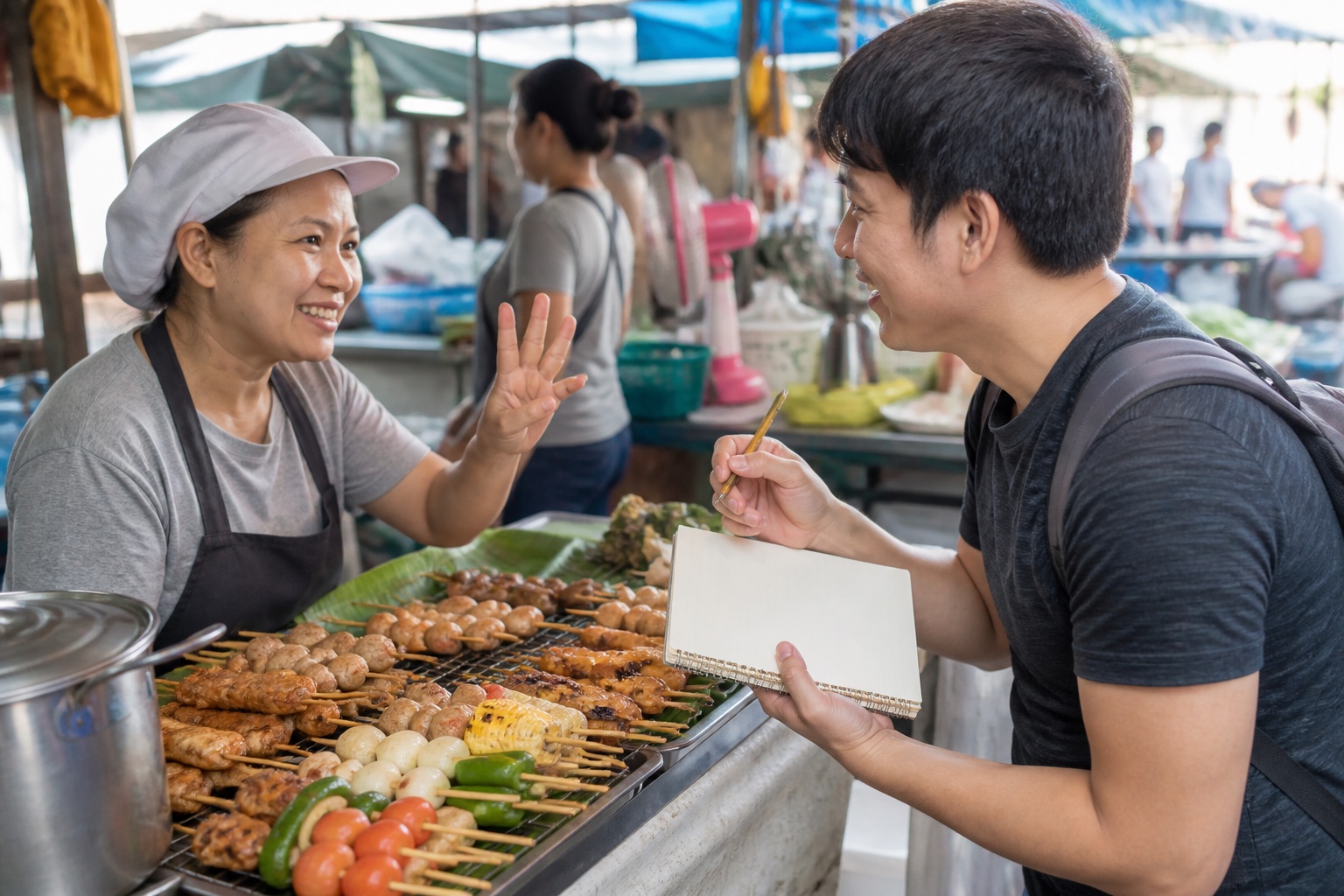
Street food is not a classroom, and vendors are not teachers. But the interaction follows a predictable pattern. If you learn the pattern, you can practice Thai in a low-stakes environment where the goal is clear: get food.
Start with a greeting. “สวัสดีครับ” (sawatdi khrap) or “สวัสดีคะ” (sawatdi kha). Then order. Then answer the vendor’s questions. The most common questions are:
- “เผ็ดไหม” (phet mai) - Spicy or not?
- “ใส่อะไร” (sai arai) - What do you want in it?
- “ทานที่นี่หรือกลับบ้าน” (than thi ni rue klap ban) - Eat here or take away?
- “รับอะไรเพิ่มไหม” (rap arai phoem mai) - Do you want anything else?
You do not need to understand every word. You need to recognize the key word: “เผ็ด” (phet) for spice, “ที่นี่” (thi ni) for eat here, “กลับบ้าน” (klap ban) for take away. If you do not understand, you can say “พูดช้าๆ ได้ไหม” (phut cha cha dai mai), which means “Can you speak slowly?”
Common Mistakes to Avoid
Do not say “ขอ” (kho) for everything. “ขอ” (kho) means “may I have” and is polite, but “เอา” (ao) is more common at street stalls. Both are acceptable. “เอา” (ao) is more direct and natural for casual ordering.
Do not use “ครับ” (khrap) or “คะ” (kha) after every single word. One polite particle at the end of a phrase is enough. Overusing it sounds unnatural.
Do not assume every vendor speaks English. Many do not. Pointing, smiling, and using short Thai phrases works better than long English sentences.
Do not touch food with your left hand if you are eating with your hands. In Thai culture, the left hand is traditionally used for cleaning. Most street food is eaten with a spoon and fork, so this is less of an issue, but it is good to know.
How Bangkok Language School Can Help
Learning to order street food is a practical skill, but it is only one part of learning Thai. A structured course helps you understand tones, sentence patterns, and cultural context in a way that random street interactions cannot. Bangkok Language School offers Thai courses with certified teachers and ED Visa support for learners who want to study in Thailand. You can practice what you learn in class at any street food stall in Bangkok. See the school’s Thai language courses for a structured starting point.
FAQ
Is Thai street food safe for foreigners?
Most street food in Bangkok can be enjoyed with sensible precautions. Choose busy stalls with high turnover, prefer food cooked thoroughly in front of you, and use safe water. The World Health Organization’s Five Keys to Safer Food provides the general food-safety principles; it does not certify any individual vendor.
How do I ask for no spice in Thai?
Say “ไม่เผ็ด” (mai phet). If you want a little spice, say “เผ็ดน้อย” (phet noi). Be aware that some dishes are made with chili paste in the cooking process, so the vendor may not be able to remove all spice.
What is the polite particle in Thai?
Female speakers commonly use “ค่ะ” (kha) for ordinary statements and “คะ” (kha) in many questions. Male speakers commonly use “ครับ” (khrap). The particle goes at the end of a phrase or sentence and makes the interaction more polite.
Do I need to know Thai to order street food?
No. Many vendors understand pointing and basic English. But learning a few phrases makes the experience smoother and shows respect. It also gives you real practice with tones and listening.
What is the difference between “เอา” (ao) and “ขอ” (kho)?
Both mean “I want” or “may I have.” “เอา” (ao) is more casual and common at street stalls. “ขอ” (kho) is more polite and formal. Both are acceptable for ordering food.
Can I use street food as Thai practice?
Yes. Street food interactions are short, repetitive, and context-rich. They are ideal for practicing numbers, classifiers, food names, and polite particles. Start with one or two phrases and build from there.