What Is Thailand Known For?
Discover what Thailand is known for, from food, islands and temples to markets, festivals, Muay Thai and traditional massage, with useful cultural context.
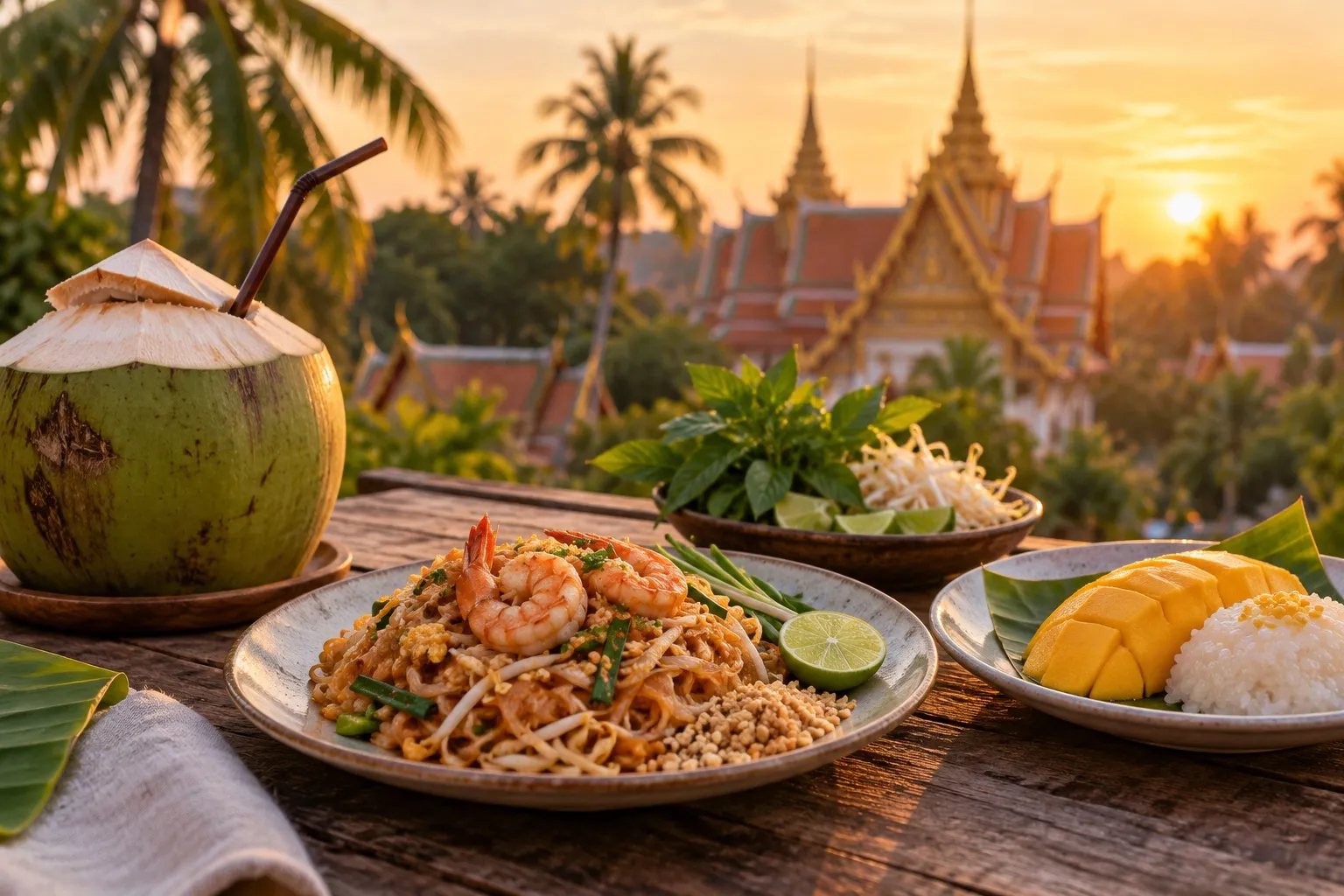
Thailand is best known for Thai food, tropical beaches and islands, Buddhist temples, historic cities, lively markets and festivals, Muay Thai, traditional massage and a culture of courteous social interaction. If you are planning a first trip, a move or a period of study, that single sentence answers the question of what is Thailand known for in broad terms. The rest of this guide explains what each of those categories actually involves, so you can choose what to explore first.
No single experience defines the country. Its best-known attractions span cities, historic sites, islands, beaches, food, markets, festivals, martial arts and wellness traditions. That range is why 2 visitors can describe completely different trips and both be accurate.
This article works through each category in turn, with practical starting points and links to our deeper guides on food, temples, islands and Thai culture. If you want surprising factual detail instead, our fun facts about Thailand article is the place for that.
Thai Food and Regional Variety
Thai food is characterized by layered tastes, aromas and textures, with substantial regional variety. That layering is the real story of the cuisine. A single dish can combine several taste dimensions at once, so the same plate can taste different on the second bite. This is also why ordering several dishes and sharing them, the local pattern, works so well: you experience the contrasts the cuisine is built around.
The other defining feature is variety. Thailand offers substantial regional differences in ingredients and preparation, so the food you encounter in 1 part of the country can differ noticeably from another. Cooking classes and markets appear among the country’s official visitor-experience categories, which makes them 2 of the most accessible ways to engage with the cuisine as a newcomer. A cooking class in particular teaches you the names of ingredients and the logic behind the layering, not just a recipe.
The practical point for a first-time visitor: do not expect a uniform national flavour. Order, taste and compare, and note which regional styles you prefer so you can seek them out again. If a dish is too intense or too mild for you, say so; cooks adjust. Our guide to Thai street food goes deeper into dishes, tastes and how to order them.
Beaches, Islands and National Parks

Thailand’s beaches and islands are among its best-known attractions, and national parks add inland variety to the same reputation. Official tourism overviews list beaches, cultural events, national parks and other varied visitor experiences alongside each other, which reflects how most visitors actually encounter the country’s natural side.
For planning, the range matters more than picking 1 famous stretch of sand. You can structure a trip around islands, around national parks, or around a mix of both. Seasonal conditions vary by region, so avoid assuming 1 time of year is best everywhere. Checking conditions for the specific region you plan to visit gives you a far more reliable picture than any nationwide rule of thumb.
The Thailand official visitor overview lists these categories together, which is a useful signal that a mixed itinerary, coast plus interior, is a normal and well-supported way to see the country. If islands are your priority, our guide to the islands of Thailand covers them island by island so you can match the right 1 to your trip.
Buddhist Temples and Historic Cities
Buddhist temples and historic cities are central to what Thailand is known for. The history connecting them is worth understanding before your first visit, because it explains why temple architecture and historic ruins look the way they do.
Ayutthaya is the clearest example. It was founded around 1350, became the second Siamese capital after Sukhothai and developed as a major centre of diplomacy and commerce. That diplomatic and commercial role matters: the city grew wealthy and cosmopolitan, and the remains you visit today show the scale of that era. It pairs naturally with Bangkok’s living temple culture, giving you both the historical thread and the present-day practice in a single trip.
Temples are not museum pieces. They remain active places of worship, so a respectful visit means modest dress and a calm manner. Observing quietly and following the lead of local visitors works well, and it turns a sightseeing stop into a genuine cultural encounter. For site-by-site guidance, see our guide to temples in Thailand.
Markets and Shopping

Lively markets and shopping are among Thailand’s signature experiences. They are also the place where the other categories on this list can meet: a single market visit can combine food, crafts and the everyday rhythm of city life.
Thailand’s official visitor overview lists shopping and markets alongside beaches, food and cultural events, which is a fair reflection of how central they are to a trip. Cooking classes appear in the same official list, so a market followed by a class is a realistic pairing for a visitor who wants to go from tasting to understanding.
Treat a market visit as a tasting tour and an orientation session in 1. You may sample dishes you have not seen on restaurant menus, watch craft traditions in progress and practise simple exchanges, all useful preparation for the rest of your trip. What any individual market offers varies, so go with curiosity rather than a fixed checklist.
Festivals: Songkran and Loi Krathong

Songkran and Loi Krathong are among Thailand’s best-known festivals, while many other celebrations are local or regional. That balance is worth knowing before you plan around a festival.
Each of the 2 has a distinctive character, and both are prominent enough that timing a trip around them is a common reason people choose their travel dates. Beyond them, many celebrations across the country are local or regional, so depending on where and when you travel, you may encounter a smaller festival that adds something memorable to your trip even though it is not among the best-known names.
This regional character is a feature, not a gap. It means festival experiences differ across the country, and asking locally what is being celebrated during your stay can lead you to events no itinerary would surface. For the cultural background behind these celebrations, our guide to Thailand culture covers the context in more depth.
Muay Thai and Nuad Thai Wellness Traditions
Muay Thai and Nuad Thai, traditional Thai massage, are 2 signature Thai practices with documented cultural standing: Nuad Thai is inscribed on UNESCO’s heritage list, while Thai public agencies present Muay Thai as part of the country’s cultural identity. They represent the physical-practice side of that identity: 1 combative, 1 restorative.
Muay Thai is presented by Thai public agencies as both a traditional martial art and a living part of Thailand’s cultural identity. That framing matters because it positions the practice as heritage rather than spectacle. As a visitor, you can encounter it in several forms, as a sport to watch, as training and as a cultural touchstone people speak about with pride, and knowing the heritage framing helps you read what you see.
Nuad Thai, traditional Thai massage, is inscribed on UNESCO’s Representative List of the Intangible Cultural Heritage of Humanity. For visitors, this inscription is the formal recognition behind a wellness tradition that has travelled worldwide under the Thai name. It is a useful example of how a local practice becomes internationally known while keeping its cultural roots visible.
The Wai and Courteous Social Interaction
A culture of courteous social interaction, including the wai greeting, is part of what Thailand is known for. The wai is a Thai gesture used in greetings and other expressions of respect, with meaning shaped by context and social relationship.
Context matters because the wai’s meaning depends on who is greeting whom and in what situation. Visitors are not expected to initiate one in every exchange. Observe how Thai people around you respond, and use a polite smile when you are unsure.
For a practical starting point, learn the spoken greeting that travels with the wai: สวัสดีครับ (sawatdee khrap) for male speakers and สวัสดีค่ะ (sawatdee kha) for female speakers. The polite ending, ครับ (khrap) or ค่ะ (kha), signals courtesy in almost any exchange, so it is useful to learn on day 1. Say it with the wai and you cover both the gesture and the spoken courtesy in 1 move.
A little Thai deepens every category in this article, from market stalls to temple visits. If you will be in Bangkok for a while, our Thai language course is the structured way to build on that first phrase.
FAQs About What Thailand Is Known For
What is Thailand most famous for?
Thailand is most famous for its food, beaches and islands, Buddhist temples, historic cities, markets, festivals, Muay Thai and traditional massage. Because the country’s recognised attractions span cities, historic sites, food, martial arts and wellness traditions, different visitors know Thailand through very different highlights, and all of them are accurate.
Is Thailand known for more than beaches and temples?
Yes, Thailand is known for far more than beaches and temples. The country’s recognised attractions also include food, markets, festivals, Muay Thai, wellness traditions such as traditional Thai massage, historic cities and national parks. Muay Thai in particular is presented by Thai public agencies as both a traditional martial art and a living part of the country’s cultural identity.
What are Thailand’s best-known festivals?
Songkran and Loi Krathong are Thailand’s best-known festivals. Many other celebrations across the country are local or regional, so visitors travelling outside those 2 may still encounter smaller events. If festival timing matters to your trip, check what is celebrated locally where you will be, not just the best-known names.
Is Thai massage recognised as cultural heritage?
Yes, Thai massage is recognised as cultural heritage. Nuad Thai, traditional Thai massage, is inscribed on UNESCO’s Representative List of the Intangible Cultural Heritage of Humanity. That inscription reflects the practice’s standing as a living tradition rather than a spa trend.
How is this guide different from a fun-facts list about Thailand?
This guide explains the signature experiences Thailand is known for and gives you practical starting points for each category. A fun-facts list, like our fun facts about Thailand article, is built for surprising factual detail instead. Use this page to plan what to explore and the fun-facts page when you want the unexpected details behind it.