Ancient City Bangkok: Plan Your Muang Boran Visit
Plan a visit to Ancient City Bangkok with ticket guidance, transport options, Muang Boran landmarks and a practical route through the park before you go.
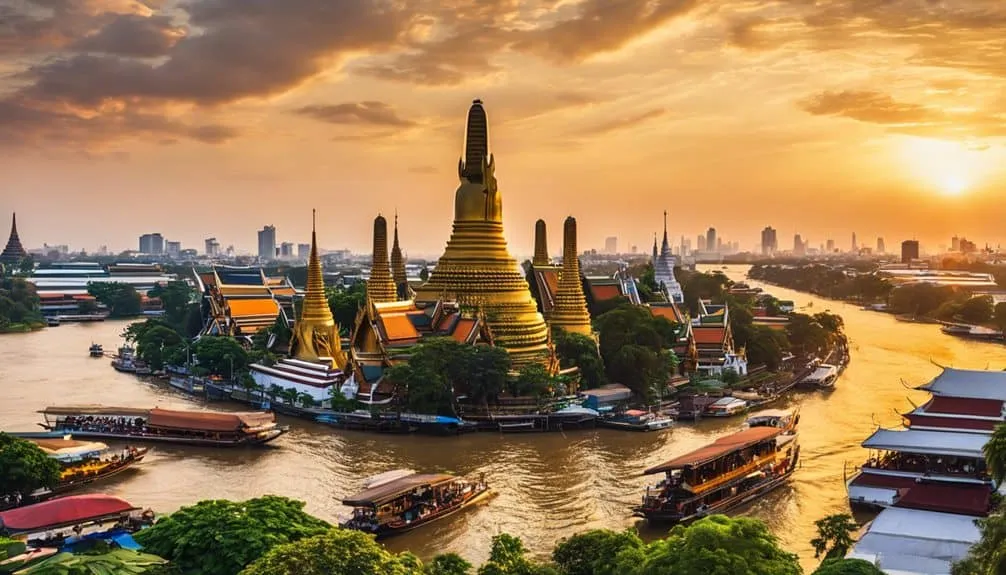
Ancient City Bangkok, officially called Muang Boran, is a 316-acre open-air museum in Samut Prakan. The park arranges replicas, reconstructions and representative Thai buildings across grounds shaped like a map of Thailand.
This guide answers the questions that matter before a visit: what the park is, whether it is worth your time, what tickets may cost, how to reach it from Bangkok and which route to follow inside.
What should you know before visiting Ancient City Bangkok?
Ancient City Bangkok opens daily from 09:00 to 19:00, with ticket sales closing at 18:00. The official Muang Boran website currently shows conflicting foreign admission prices, so use the higher figure when setting your budget and verify it before leaving.
Here is what the official pages state as of the research date:
- Daily opening hours: 09:00 to 19:00
- Ticket sales close: 18:00
- Foreign adult budgeting figure: 800 THB
- Foreign child budgeting figure, ages 6 to 14: 400 THB
- Thai adult admission, official Thai ticket page: 400 THB
- Thai child admission, ages 6 to 14, official Thai ticket page: 250 THB
The English ticket page also states that foreign visitors living in Thailand may qualify for Thai pricing if they hold a work permit or Thai driving licence. Do not assume this applies to you. Bring the document and expect staff to verify it.
For budgeting, use the higher foreign figures of 800 THB for adults and 400 THB for children. The official access page still shows 700 THB and 350 THB, so verify the amount before paying.
Check the official Muang Boran website immediately before visiting. The conflict may be resolved by the time you travel.
What is Ancient City Bangkok?
Ancient City Bangkok is a large open-air museum in Samut Prakan, not a single ancient monument in central Bangkok. Its Thai name, Muang Boran, means Ancient City.
Muang Boran is the Thai name you will see on signs and official materials. The park is divided into northern, northeastern, central and southern sections, mirroring Thailand’s actual regions. That layout is the key to understanding the attraction. You are not walking through a temple complex. You are moving through a compressed cultural geography of Thailand.
The buildings are not original monuments moved from their home provinces. Many are replicas or reconstructions. Some are scaled down. Others are full-size or near full-size. This distinction matters because it changes how you should judge the experience. You are not seeing “the real thing.” You are seeing a curated overview of Thailand’s architectural and cultural variety in the same location.
That is also the attraction’s main strength. A visitor with 1 day in Bangkok cannot reasonably visit ancient temple sites in Chiang Mai, Isan and the deep south. At Muang Boran, you can compare representative structures from those regions. For cultural learning, it is a shortcut, not a substitute.
Why does the map layout matter?
The regional layout makes route planning intuitive. You can follow the northern, northeastern, central and southern zones instead of memorizing a long list of structure names. The park’s shape follows the country’s shape, so its regional sections correspond broadly to their positions on a map of Thailand.
Is Ancient City Bangkok worth visiting?
Ancient City Bangkok is worth visiting if you want a broad introduction to Thai architecture and regional culture in 1 place. It is less suitable if you expect an archaeological site filled with original monuments.
The park works as an overview. It places northern, northeastern, central and southern architectural references within a geographic layout that is easy to understand. That makes Muang Boran useful near the start of a longer Thailand trip, when the buildings can give context to places you may visit later.
The tradeoff is authenticity. Replicas and reconstructions cannot replace Ayutthaya, Sukhothai or the original temples represented in the park. Visit for comparison, scale and cultural orientation, not because the site is an untouched ancient city.
What are the best things to see at Ancient City Bangkok?
These 6 highlights give an initial visitor a useful mix of palace, pavilion, gateway and stupa architecture. Choose the structures that interest you before you start rather than treating the list as a fixed route.
1. Sanphet Prasat Palace
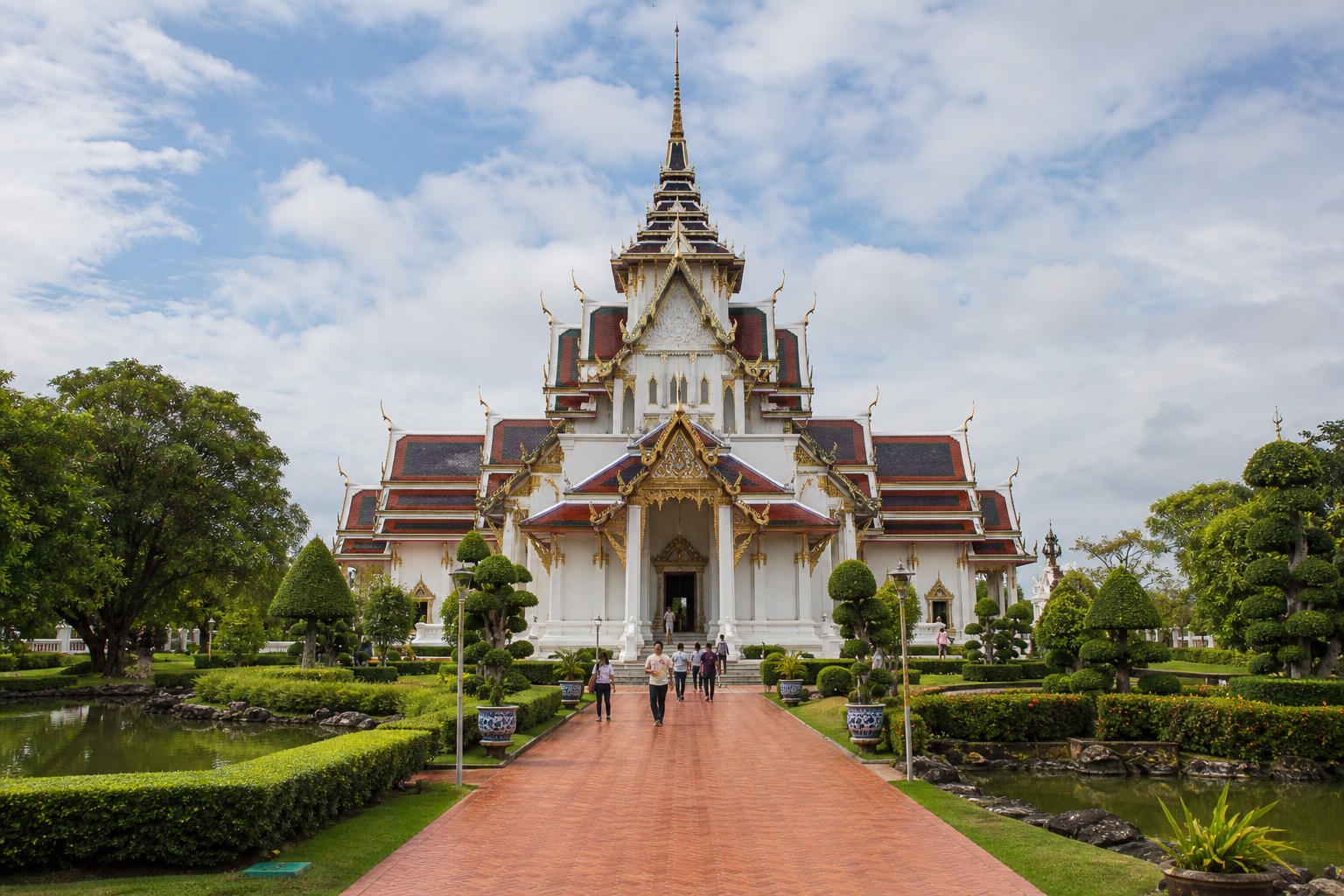
Sanphet Prasat Palace is a major Muang Boran reconstruction based on archaeological and historical evidence. The museum states that the original Ayutthaya palace was destroyed in 1767 and that this reconstruction welcomed Queen Elizabeth II and her consort in 1972.
2. The Phra Kaew Pavilion
The Phra Kaew Pavilion is described in the museum’s materials as an octagonal structure based on an Ayutthaya-period carved pavilion. Prioritize it if you want to examine its distinctive shape and carved details at close range.
3. The Ancient Theatrical Pavilion
The Ancient Theatrical Pavilion connects with court performances and sits near related sites listed in the museum’s materials. This structure helps you understand the performance and entertainment culture that existed alongside the religious and royal architecture.
4. The City Wall and Gate
The City Wall and Gate serves as the entrance to the park and is modeled after a historic stone fence at Maha That Temple in Chalieng, Sukhothai Province. Do not rush past this structure. It sets the scale for what follows and provides a useful orientation point before you choose your transport around the park. You are seeing a deliberate historical reference rather than a generic entrance design.
5. The Garden of Sacred Stupa
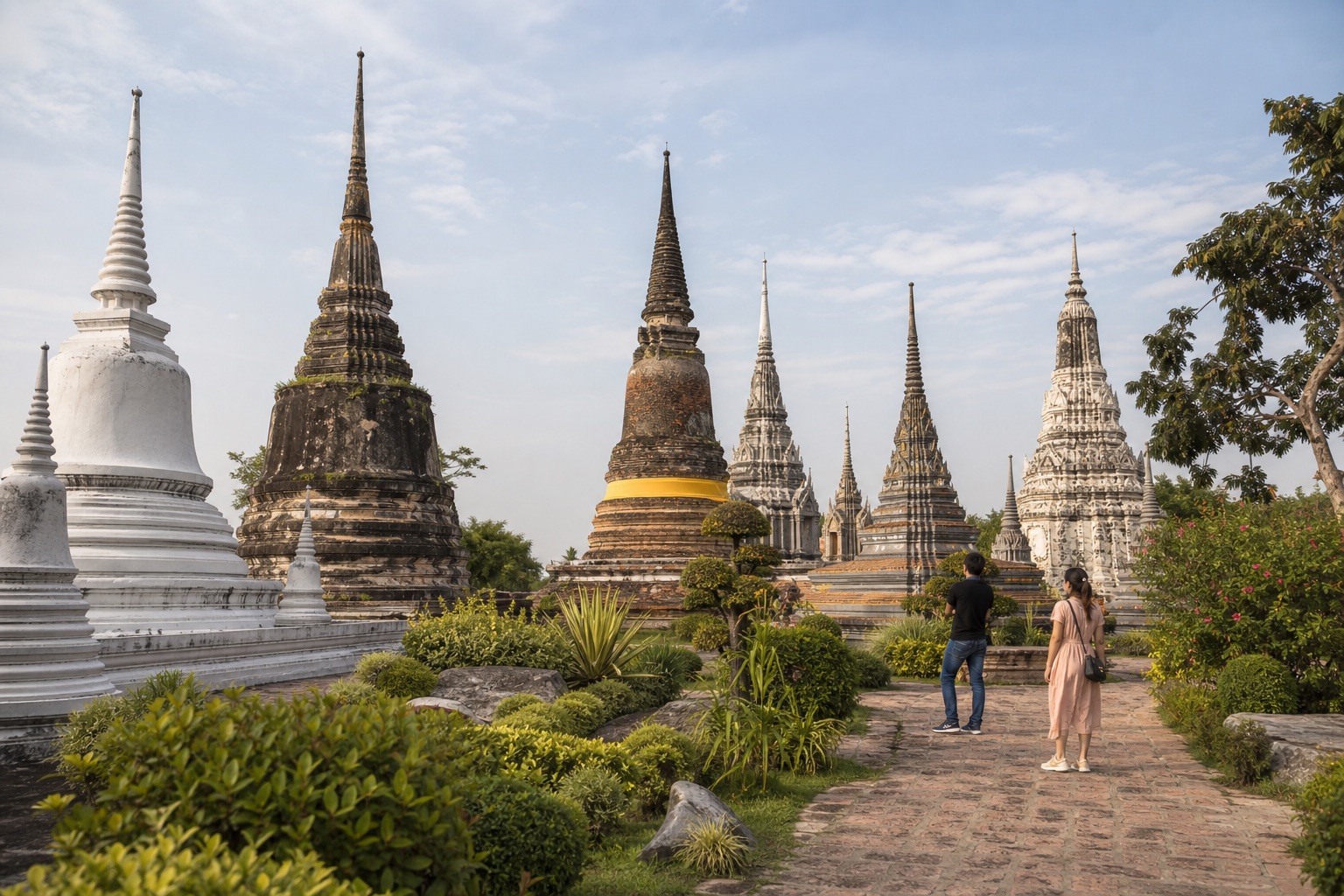
The Garden of Sacred Stupa contains chedi in different architectural styles and periods. It lets you compare the similarities and differences among regional stupa forms in a single area.
6. The Information Pavilion
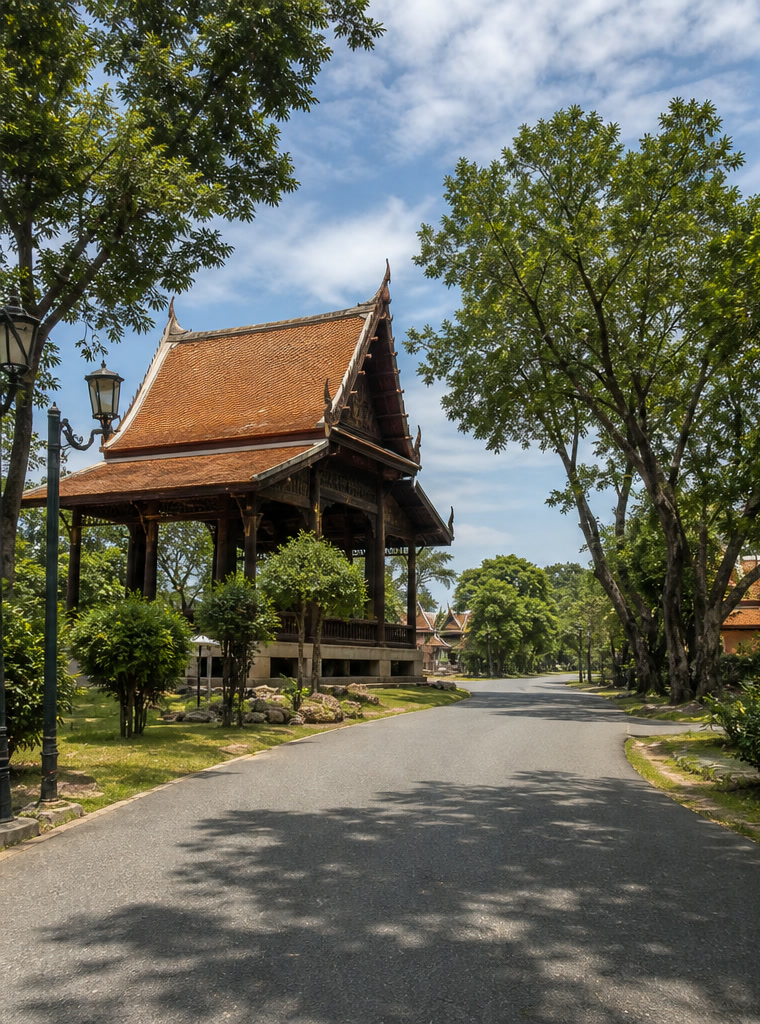
The Information Pavilion is a Sukhothai-style pavilion based on the traditional shelters built outside city walls for travellers waiting to enter. Its steep roof, round wooden pillars and beams show how a sala combined practical shelter with architectural form.
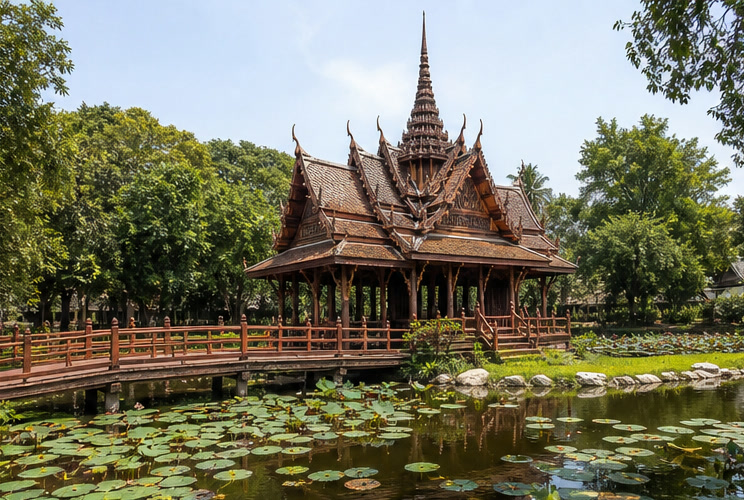
Use these 6 structures as a shortlist, then check their numbered locations on the current park map. They are not presented here as a walking sequence.
How do you get to Ancient City Bangkok from Bangkok?
The simplest public-transport route is the BTS Sukhumvit Line to Kheha station, followed by a short local connection to Muang Boran. A taxi or ride-hailing car from central Bangkok removes the transfer but makes the journey more dependent on road traffic.
How do you reach Muang Boran from BTS Kheha?
Take the BTS Sukhumvit Line to Kheha, the final station. From there, you need a local connection to the park entrance. Several travel guides mention songthaew route 36 as the standard option, but treat the fare and frequency as visitor-reported rather than official. Songthaews are shared local trucks that follow fixed routes. Follow the driver’s instructions and confirm the current fare before boarding.
Carrying some cash is a practical precaution for local transport. Confirm the current payment options before you travel.
Should you take a taxi or private car?
A taxi from central Bangkok to Ancient City removes the BTS-to-songthaew transfer. The address for your driver is:
296/1 Moo 7 Sukhumvit Road, Bangpoomai, Samut Prakan 10280
Do not rely on drivers knowing “Ancient City.” Show the Thai name, เมืองโบราณ (mueang boran), or the full address. If you are using a ride-hailing app, set the destination in advance and check the price before confirming. Fixed travel times and fares are not given here because traffic on Sukhumvit Road varies widely by time of day.
How do you return to Bangkok?
Plan your return before you enter. If you arrive by songthaew, confirm where to board for BTS Kheha and whether the current service fits your exit time. If you take a taxi, check whether you can request another car at the park exit or need to arrange a pickup.
The practical rule: do not assume the return journey mirrors the outbound journey. Give yourself extra time if you plan to stay until closing.
How much are Ancient City Bangkok tickets?
Budget 800 THB for a foreign adult and 400 THB for a foreign child aged 6 to 14. These are the higher figures shown across the conflicting official pages, so they are safer for planning than the lower 700 THB and 350 THB figures.
| Item | Detail |
|---|---|
| Opening hours | 09:00 to 19:00 daily |
| Ticket sales close | 18:00 |
| Foreign adult budgeting figure | 800 THB |
| Foreign child budgeting figure, ages 6 to 14 | 400 THB |
| Thai adult, official Thai page | 400 THB |
| Thai child, ages 6 to 14, official Thai page | 250 THB |
| Thai-pricing note | Work permit or Thai driving licence may qualify |
The official pages are inconsistent. Check the official Muang Boran website linked above before visiting and confirm the actual amount at the entrance.
What is the best way to travel around Muang Boran?
Choose a bicycle for flexibility, a tram for lower physical effort or a golf cart for a private route. Walking alone limits how much of the 316-acre park you can cover comfortably, especially in hot weather.
Bicycle, tram, golf cart or car
- Bicycle gives you independence and lets you stop exactly where you want. It requires reasonable fitness and a tolerance for heat.
- Tram is the low-effort option and works well if you want an overview without cycling. It is less flexible because you move at the tram’s pace.
- Golf cart offers privacy and flexibility for visitors who do not want to cycle. Current rental price and conditions need verification before you rely on this option.
- Car is an option if you have your own transport, but you lose the experience of moving through the park at a human pace.
What route should an initial visitor follow?
Start at the City Wall and Gate, then use the current official map to choose a manageable group of numbered sites. The park’s regional layout helps you compare northern, northeastern, central and southern architecture, but the 6 highlights above are not listed in walking order.
Plan regular water and shade breaks, more often in hot weather. The park has open areas with limited cover, so plan around the heat rather than fighting it. If you start early, the temperature may be more comfortable, but check current conditions before you go.
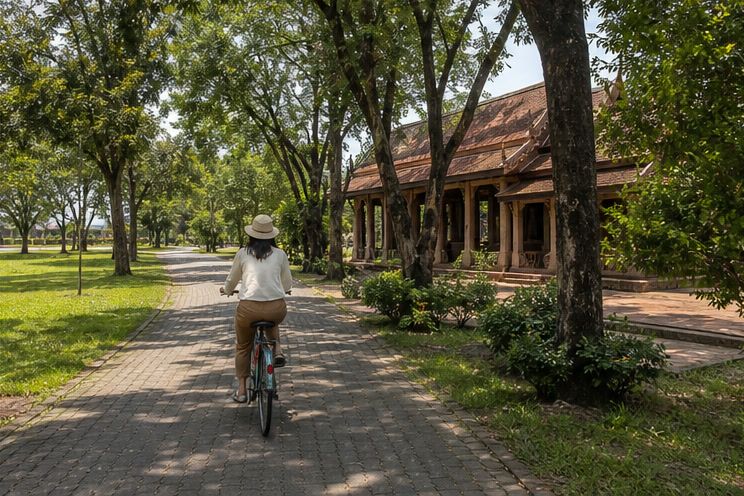
Skip sections freely. A focused route through the structures that interest you is easier to manage than trying to stop at every listed site.
How long should you spend at Ancient City Bangkok?
Allow about 4 hours for a focused highlights route or most of a day for a slower regional circuit. Your transport choice matters more than your walking speed because the park covers 316 acres.
A practical 4-hour route
Use the current park map to select about 4 priority structures plus nearby stops. Group sites by their numbered locations instead of crossing the park repeatedly, and leave enough time to return your bicycle or golf cart before departure.
This route favors the strongest contrasts rather than the largest number of stops. Use a bicycle or golf cart if you want control over timing. A tram works when reduced walking matters more than choosing every stop.
A practical full-day route
Use the regional layout to divide a full day into 2 or 3 zones. Start with the outdoor areas you most want to see, pause during the hottest part of the day, then continue with the remaining zones that fit your transport and energy level.
Build in time for structures that are not on your original list. The value of a full-day visit is the ability to stop when a building, garden or regional style gives you something worth studying.
What should you wear and bring to Muang Boran?
Wear light, modest clothing and comfortable shoes, then bring water and sun protection. Muang Boran is primarily outdoors, and the distance between structures makes heat management part of the visit.
Food and Water
The official site once listed a notice that the floating market visit point was closed for renovation. Do not assume the floating market is open or that food is available at every section. Bring water, especially in hot months. If you plan to eat inside the park, verify current food options before your visit or carry snacks.
Facilities and accessibility
Some areas are large and open. Shade can be limited. Restroom locations and current conditions need on-site confirmation. If you have mobility needs, contact the park before travelling and ask about the specific route, building access and vehicle option you require. Do not assume that every structure is step-free.
Etiquette
Temple-style structures deserve respectful behavior even when they are replicas. Dress modestly: shoulders covered and knees covered is a safe baseline. Remove shoes where signs indicate. Do not climb on structures or touch delicate carvings. Speak quietly inside buildings.
Heat and Timing
The biggest practical risk is underestimating heat and distance. Wear sun protection, carry water, and plan to rest in shaded areas. A morning start gives you the most comfortable conditions and the best photography light.
Which Thai phrases are useful at Ancient City Bangkok?
These 5 Thai phrases help with transport, directions and tickets at Muang Boran. Thai speakers may answer quickly, so show the written phrase on your phone if you cannot follow the reply.
| English | Thai | Simple pronunciation |
|---|---|---|
| Ancient City | เมืองโบราณ | mueang boran |
| Ancient City, please | ไปเมืองโบราณครับ/ค่ะ | pai mueang boran khrap/kha |
| How much is the ticket? | ตั๋วราคาเท่าไหร่ครับ/คะ | tua rakha thao rai khrap/kha |
| Where is the entrance? | ทางเข้าอยู่ตรงไหนครับ/คะ | thang khao yu trong nai khrap/kha |
| BTS Kheha, please | ไปบีทีเอสเคหะครับ/ค่ะ | pai BTS Kheha khrap/kha |
Men normally end polite statements with ครับ (khrap), while women normally use ค่ะ (kha). In questions, women use คะ (kha) with a rising tone. See our practical Thai phrases guide for more transport and everyday language.
Bangkok Language School teaches practical Thai for situations such as asking directions, using local transport and understanding polite replies. If you are staying in Bangkok longer, compare the available Thai language course options.
Frequently asked questions about Ancient City Bangkok
Is Ancient City actually in Bangkok?
The official address is in Bangpoomai, Samut Prakan. It is commonly marketed as a Bangkok attraction because it is a realistic day trip from the city. Do not confuse it with Bangkok’s historic Old City around Rattanakosin.
What is the current foreign ticket price?
For budgeting, use 800 THB for foreign adults and 400 THB for children aged 6 to 14. The official access page also shows lower figures of 700 THB and 350 THB, so verify the final amount directly before visiting.
Can you walk around the whole park?
The park is 316 acres, so walking limits how many structures you can study during a visit. Choose a bicycle, tram, golf cart or car if you want to cover more of the grounds.
What is the best time to visit?
A morning start may be more comfortable, but check current conditions before you go. The park opens at 09:00 and ticket sales close at 18:00.
What should I know about food and accessibility?
Food options and the floating market area’s status can change, so bring water and verify current dining details before you go. The park is large and primarily outdoors. Ask the park directly about step-free routes, building access and current transport options before relying on an accessibility plan.