15 Facts About Bangkok: History, People and City Life
Explore 15 facts about Bangkok, including its official name, 1782 founding, 50 districts, registered population, river, BTS and UNESCO design status.
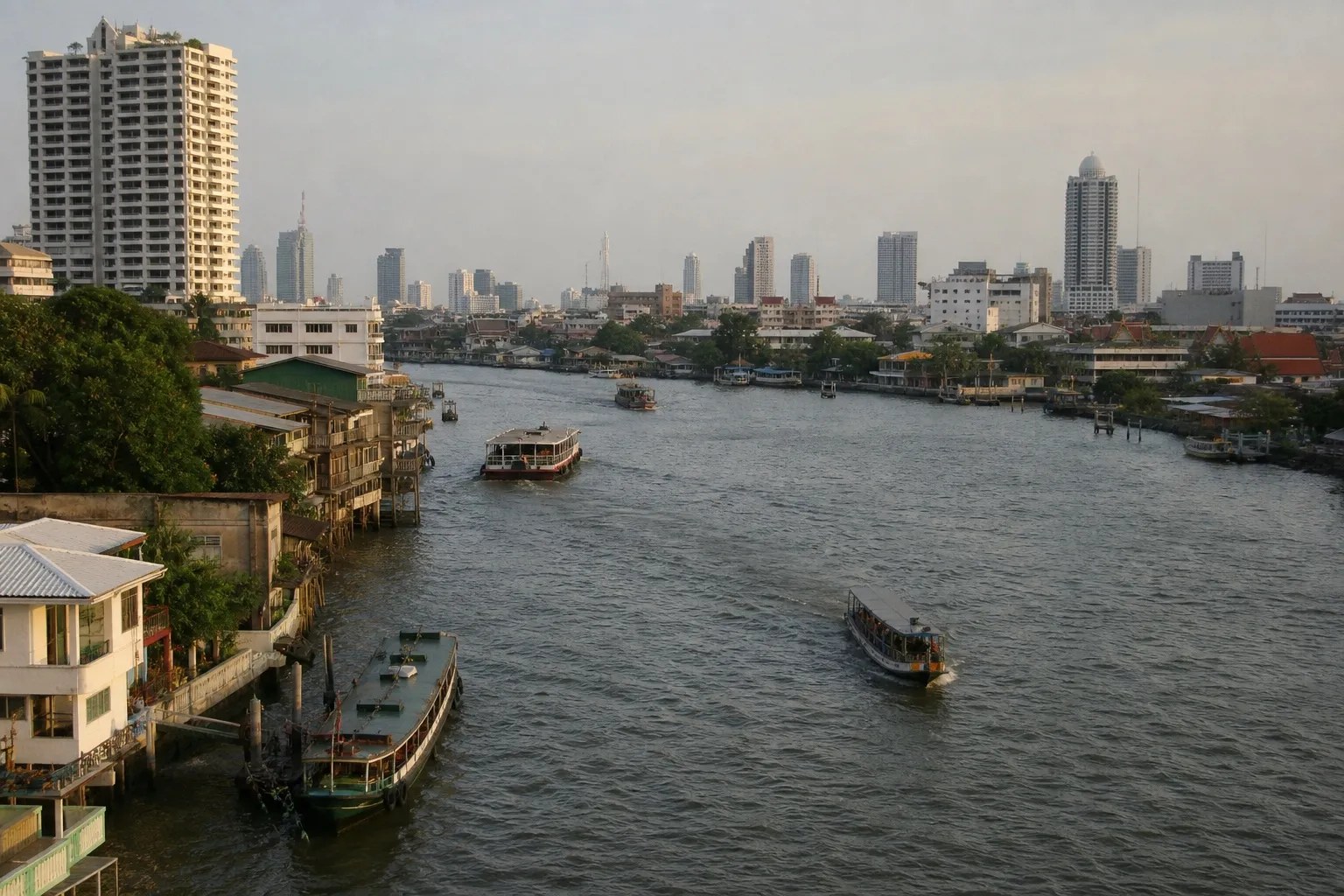
Bangkok is Thailand’s capital and is also called Krung Thep Maha Nakhon. This evidence-led guide answers the query facts about bangkok immediately. Thailand’s National Statistical Office records 5,455,020 registered residents in Bangkok’s 50 district administrative area in 2024. Wider regional and urban estimates use different boundaries, so they should not be compared without a named geography, year and method.
This guide uses official records rather than common travel myths. Each fact below names a source, a year and a geography where the data require it. Primary records include the Bangkok Metropolitan Administration, Thailand’s National Statistical Office, BTS, UNESCO and the official international geographic name list. The goal is to show what a source actually supports, not to repeat unsourced superlatives.
| Fact | Detail | Source |
|---|---|---|
| Official name | Krung Thep Maha Nakhon; Bangkok |
BMA |
| Founded | 21 April 1782 | TAT News |
| Area | 1,568.737 sq km | BMA |
| Districts | 50 | BMA |
| Registered population 2024 | 5,455,020 | NSO |
| Registered density 2024 | 3,477.3 per sq km | NSO |
Bangkok’s Official Identity and Name
Fact 1: Bangkok is Thailand’s capital and its official Thai administrative name is Krung Thep Maha Nakhon
Bangkok is Thailand’s capital and is administered as Krung Thep Maha Nakhon. The Bangkok Metropolitan Administration states that Bangkok is Thailand’s capital and is also called Krung Thep Maha Nakhon. The official international geographic name is Krung Thep Maha Nakhon; Bangkok. This name combines the Thai administrative form and the English form in a single official reference.
The administrative name and the English name are not separate places. Krung Thep Maha Nakhon is the Thai administrative unit, while Bangkok is the widely used English name. Both appear in the official international geographic name as a pair. This helps official records remain consistent across Thai and English contexts.
Many readers see Bangkok and Krung Thep Maha Nakhon as competing names. In practice, they are linked in the official geographic name. The link matters for legal, civic and language use. The Bangkok Metropolitan Administration page confirms the capital status and the city’s administrative identity.
The Founding of Bangkok in 1782
Fact 2: Bangkok was founded as the Rattanakosin capital on 21 April 1782
Bangkok was established on 21 April 1782 by King Rama I as the Rattanakosin capital. TAT News confirms that Bangkok was established as the Rattanakosin capital on 21 April 1782. The date marks the start of the Rattanakosin period and the city’s central role in the current dynasty. Rattanakosin Island is Bangkok’s Old Town and lies along the Chao Phraya River in Phra Nakhon district.
The 1782 founding date anchors Bangkok’s history because it begins the city as capital of the Rattanakosin era. Before 1782, the region had other settlements and capitals, but Bangkok’s official role as capital starts here. The founding date also explains why Rattanakosin Island is treated as the historic core. The city grew outward from that original riverfront core.
A common mistake is to present Bangkok’s founding as the beginning of all Thai history. The founding date applies to Bangkok as the Rattanakosin capital, not to the entire region. The older history of the Chao Phraya basin exists separately. The wider timeline is covered in Thailand’s history.
Using the exact date helps readers separate earlier history from Bangkok’s period as capital. It also shows that the Old Town is more than a visitor district: it is the founding centre of the administrative city. The location on the Chao Phraya gave the early capital strategic and ceremonial value. That geography is still visible today.

Bangkok’s Geography, Area and Districts
Fact 3: Bangkok covers an area of 1,568.737 square kilometres
Bangkok’s total area is 1,568.737 square kilometres. The Bangkok Metropolitan Administration reports this figure for the city area. This measurement covers the special administrative area of Bangkok. It does not cover the wider Bangkok Metropolitan Region or the surrounding urban agglomeration.
The area figure is useful because it defines the official geography. Bangkok’s 50 districts sit within this boundary. Surrounding provinces such as Pathum Thani and Samut Prakan are outside this administrative area. Transport lines connect those provinces to Bangkok, but they are not part of the 1,568.737 square kilometre city.
This distinction is a frequent source of misreading. A source may describe Bangkok’s economic zone or labour market area, which can be much larger. Unless the source names the boundary, that larger number should not be compared with the BMA area. The 1,568.737 square kilometre figure is the correct reference for the administrative city.
Fact 4: Bangkok is divided into 50 administrative districts
Bangkok has 50 administrative districts. The Bangkok Metropolitan Administration’s district portal lists 50 districts. These districts cover inner city areas such as Phra Nakhon and outer suburban zones. The district count applies to Bangkok as a special administrative area, not to surrounding metro provinces.
Each district is a local administrative unit within the city. The 50 district structure helps the city manage local administration and service delivery. Districts vary in size and population across the 1,568.737 square kilometre area. Phra Nakhon contains the historic Old Town, while outer districts show the city’s suburban spread.
The district count can be misread as a cultural neighbourhood count. Districts are administrative units, not tourism or cultural neighbourhoods. Visitors may know areas such as Sukhumvit or Silom, but those do not correspond cleanly to the 50 districts in administrative records. The BMA district list is the official reference.

Bangkok’s Registered Population and Density
Fact 5: Bangkok’s registered population in 2024 was 5,455,020
Thailand’s National Statistical Office reports 5,455,020 registered residents in Bangkok for 2024. This is a dated registered population record for the administrative city. It is not a count of everyone physically present in the wider urban region. The National Statistical Office 2025 Statistical Yearbook population page provides that figure.
A registered population count is an administrative concept. It counts people whose registration records place them in Bangkok. It does not include everyone who works, studies or sleeps in the city without a Bangkok registration. The figure should therefore be described as registered residents, not the total population in every physical sense.
Larger estimates for Bangkok are not automatically false, but they require a named geography, year and method. A Bangkok Metropolitan Region estimate includes surrounding provinces. An urban agglomeration estimate uses a built up area definition that can extend beyond the 50 district boundary.
This distinction matters because population figures affect infrastructure, services and public understanding. The 2024 registered population of 5,455,020 is the precise figure for the administrative city. Any other number should state its boundary and whether it counts residents, workers, registered persons or a modelled population.
Fact 6: Bangkok’s registered population density in 2024 was 3,477.3 people per square kilometre
Bangkok’s registered population density was 3,477.3 people per square kilometre in 2024. The same National Statistical Office 2025 Statistical Yearbook reports that figure. The density comes from the registered population of 5,455,020 divided by the city area of 1,568.737 square kilometres.
Density is a derived statistic, not a separate observation. It depends on the registered population and the administrative area. Because the area is fixed at 1,568.737 square kilometres, the density changes as the registered population changes. The 2024 density is therefore directly tied to the 2024 registered population count.
This figure is often confused with urban density across the entire built up area. Bangkok’s administrative city is only part of the larger continuous urban zone. A density for the wider urban region would require a different population and a different land area. Mixing those definitions creates false comparisons with other cities.
The registered density is useful for understanding how compact the registered population is within the 50 district boundary. It also shows why population and area should be kept together. A density figure without a year or boundary has limited evidentiary value.
Bangkok’s Special Local Government
Fact 7: Bangkok is administered as a special local government, not a regular province
Bangkok is a special local government with executive and legislative branches through the Bangkok Metropolitan Administration. The BMA states that Bangkok is administered as a special local government. This status differs from Thailand’s 76 regular provinces.
The special local government structure includes executive and legislative functions. The BMA administers city services and local development within the 50 district boundary. The city is not a regular province, even though it appears in provincial level data. The precise legal status matters for governance.
This status is easy to misread because provincial data often include Bangkok as a separate entry. The city has a different local administration framework. Its population and area are reported separately by the National Statistical Office. Administrative comparisons should treat Bangkok as a special local government, not a regular province.

The Chao Phraya River and Rattanakosin Old Town
Fact 8: Rattanakosin Island, Bangkok’s Old Town, lies along the Chao Phraya River in Phra Nakhon district
Rattanakosin Island is Bangkok’s Old Town and sits along the Chao Phraya River in Phra Nakhon district. TAT News describes Rattanakosin Island as Bangkok’s Old Town along the Chao Phraya River. The area marks the founding core of the city.
Rattanakosin Island is not a coastal island. It is a historic core defined by the Chao Phraya River and former canal waterways. Its location in Phra Nakhon district ties the city’s founding date of 21 April 1782 to a specific urban geography. Historic institutions associated with the Rattanakosin period are concentrated around this area.
The Chao Phraya River is central to Bangkok’s historical geography. The riverfront position connects the Old Town to the city’s 1782 founding. This link between river and founding date helps explain the original settlement pattern. The modern city has grown far beyond this core.
Misreading can occur when Rattanakosin Island is described only as a tourism zone. The area is the founding centre of the administrative city. Its location in Phra Nakhon gives it a specific place within the 50 district structure. That historical geography remains visible even as the city expands.
Bangkok’s BTS Network Crosses Provincial Boundaries
Fact 9: The BTS SkyTrain is Thailand’s 1st electric mass-transit railway system with 2 main lines, about 68.5 kilometres and 60 stations
The BTS SkyTrain was Thailand’s 1st electric mass transit railway system and currently has 2 main lines, about 68.5 kilometres and 60 stations. BTS states that service began as the country’s 1st electric mass transit railway system. The operator describes 2 main SkyTrain lines, about 68.5 kilometres and 60 stations.
These figures apply to the BTS SkyTrain system described by the operator. They do not cover every rail line or mass transit line in Bangkok. Bangkok’s wider transit network includes other systems, but this fact is limited to the BTS SkyTrain. Keeping the system boundary clear prevents confusion.
The BTS data are often presented as if they describe all Bangkok rail. In fact, the BTS SkyTrain is 1 part of the city’s transport network. The 68.5 kilometres and 60 stations are operator figures for the BTS main lines. Other rail systems have their own route lengths and station counts.
This fact matters because transport scale is frequently used in city comparisons. A reader who wants to compare systems should compare the same operator and line set. The BTS main line figures provide a clear summary of the SkyTrain’s current scale. The next fact shows that this system crosses the administrative boundary.
Fact 10: The BTS system’s 2 main lines extend beyond Bangkok into Pathum Thani and Samut Prakan
The BTS SkyTrain’s 2 main lines extend beyond Bangkok into Pathum Thani and Samut Prakan. BTS confirms that the 2 main lines cross provincial boundaries. This shows that the lived metropolis is larger than Bangkok’s administrative area.
Pathum Thani and Samut Prakan are outside Bangkok’s 50 district administrative boundary. The BTS crossing into these provinces is direct evidence that transport networks and urban movement do not follow the city border. It also supports the distinction between Bangkok city proper and the wider transport region.
This fact is easy to misread in population discussions. A commuter may live in Samut Prakan, travel on the BTS and work in Bangkok. That person may not be counted as a Bangkok registered resident. The BTS route and the administrative boundary are different concepts.
The BTS system therefore illustrates why Bangkok the city and Bangkok the wider urban region should not be used interchangeably. Municipal boundaries are fixed for administration, while transport networks cross them. Readers can use this distinction when interpreting population, employment and daily movement data.

UNESCO: World Book Capital and Creative City of Design
Fact 11: Bangkok was UNESCO World Book Capital in 2013
Bangkok held the UNESCO World Book Capital title in 2013. UNESCO lists Bangkok as World Book Capital for that year. The title is an annual UNESCO programme designation. The source record verifies the title year, not a ranking of the city’s reading achievements.
The World Book Capital programme is a UNESCO designation connected to books and reading. The title is granted for a specific year and is listed by UNESCO. The record for Bangkok is therefore a dated programme fact. It is separate from permanent designations such as the Creative Cities Network.
A common overstatement is to treat UNESCO recognition broadly as a prize. The supplied record establishes that UNESCO listed Bangkok as World Book Capital in 2013. It does not provide a detailed review of specific city initiatives in the source material referenced here. The title should be described precisely.
Fact 12: Bangkok joined UNESCO’s Creative Cities Network as a City of Design in 2019
Bangkok is a UNESCO Creative City of Design since 2019. UNESCO attributes the designation to Bangkok’s mix of traditional and contemporary design, creative production communities and urban initiatives focused on design. The designation places Bangkok within the Creative Cities Network.
The City of Design title is a specific designation, not a general claim that Bangkok is the creative capital of the region. It highlights the city’s design sector and creative production communities. The 2019 date distinguishes it from the 2013 World Book Capital title. Both are cultural designations with different programme years.
This fact is easy to misread because UNESCO has many networks and titles. A Creative Cities Network designation does not cover every cultural field. Bangkok is listed specifically as City of Design, not as another creative field such as gastronomy or literature. Using the field name keeps the fact accurate.
This fact matters because it adds another evidence based layer to Bangkok’s cultural identity. The design recognition sits within the wider context of Thai culture. It helps readers see Bangkok’s creative institutions alongside its history and transport systems.

Everyday Language and Common Claims to Qualify
Fact 13: Everyday Thai usage favours Krung Thep or Bangkok, while the elaborate ceremonial name is cultural context, not an administrative English name
In everyday use, Thai speakers say Krung Thep, while the elaborate ceremonial name is not the ordinary administrative English name. The official international geographic name is Krung Thep Maha Nakhon; Bangkok. The long ceremonial Thai name is cultural and historical context.
The everyday Thai name Krung Thep is the standard conversational form. Bangkok is widely used in English. The official geographic name includes both forms. The ceremonial name exists, but it is not the practical administrative name printed on ordinary civic records.
Many lists call the elaborate ceremonial name the world’s longest city name. That label is not based on a verified administrative record in the supplied research. The source record treats the long name as cultural and historical context. The practical distinction should not be replaced by an unsourced superlative.
This distinction matters for Thai language learners, including students at Bangkok Language School. Learners should know that Krung Thep is the normal everyday reference. The ceremonial name is not required for ordinary communication. The learn Thai pathway can help build this contextual understanding.

Fact 14: The often quoted 10, 11 or 17 million population figures mix city, registered population, urban area and metro region without naming geography and year
Frequently quoted population figures of 10, 11 or 17 million require a named geography, year and method before they can be compared with Bangkok city proper. Larger metro or agglomeration estimates are not automatically wrong. They describe a different area from the 50 district administrative city.
Thailand’s National Statistical Office reports 5,455,020 registered residents in Bangkok for 2024. That is a registered population record for the administrative city. It does not include surrounding provinces in the Bangkok Metropolitan Region or the wider built up area.
Higher figures often refer to the Bangkok Metropolitan Region or an urban agglomeration. Each geography has a different boundary and a different meaning. A source that simply says Bangkok has 10 million people has not defined which Bangkok it means.
This qualification matters because population shapes policy, investment and public understanding. A reader should ask what geography is being counted and what population definition is used. The 2024 registered count is the precise city proper figure, while larger numbers describe a different area.
Fact 15: The supplied record does not establish a world’s hottest city ranking for Bangkok
The supplied authoritative record does not establish a world’s hottest city ranking for Bangkok. The available source record for this article contains no comparative climate dataset. The claim is common online, but no primary source in the record supports the label.
A comparative temperature claim needs a defined dataset, measurement variable and comparison period. It should specify whether it compares average temperature, maximum temperature, heat index or another measure. It should also state the set of cities and the time period. Without those parameters, a ranking cannot be verified.
This does not mean Bangkok has no climate data. It means the research record supplied here does not document climate in a way that can support the specific claim. The safest position is not to assert that Bangkok is number 1 or not number 1. Instead, the claim should be treated as unsupported unless a defined dataset is supplied.
This fact matters because it shows how evidence based editing should handle superlatives. A general impression is not the same as a comparative statistical record. Readers should ask for the dataset behind any world ranking claim.
Frequently Asked Questions About Bangkok
What is Bangkok’s official name and everyday Thai name?
Bangkok’s official international name is Krung Thep Maha Nakhon; Bangkok. In everyday Thai, the usual name is Krung Thep. Bangkok is also used in English, and the official international name includes it. The long ceremonial Thai name is cultural and historical, not the ordinary administrative English name.
This split is useful because official records and daily speech can use different names. Knowing both prevents confusion when reading Thai administrative documents or street signs.
What is Bangkok’s population?
Thailand’s National Statistical Office reports 5,455,020 registered residents in Bangkok for 2024. That figure counts people on registration records, not everyone physically present in the wider urban region. Higher figures for greater Bangkok can include surrounding provinces and different geographies.
Always check the year and boundary. The administrative city proper is the 50 district Bangkok. Larger metro estimates are not automatically wrong, but they are not the same as the registered city population.
How many districts does Bangkok have?
Bangkok has 50 administrative districts, according to the Bangkok Metropolitan Administration. The city area is 1,568.737 square kilometres. The registered population density was 3,477.3 people per square kilometre in 2024.
The 50 districts vary in size and population across the administrative area. This district count applies to Bangkok city proper, not surrounding metro provinces.
When was Bangkok founded?
Bangkok was established as the Rattanakosin capital on 21 April 1782 by King Rama I. Rattanakosin Island, the Old Town, lies along the Chao Phraya River in Phra Nakhon district. The city has grown beyond that original core while keeping the 1782 date as its founding point.
Is Bangkok a province?
Bangkok is not a regular province. It is administered as a special local government area by the Bangkok Metropolitan Administration, which has executive and legislative branches. This gives Bangkok different administrative arrangements compared with regular Thai provinces.