What Does Farang Mean in Thai?
Farang (ฝรั่ง) is a Thai word commonly used for a white Western foreigner, and it also means guava. Learn its pronunciation, context, and alternatives.

Farang (ฝรั่ง) is a Thai word commonly used for a white Western foreigner, and it also means guava when people are talking about fruit. If you are learning the farang meaning in everyday use, the short version is this: it is a common descriptive word you will hear in Thailand, how it lands depends on tone and context, and the same spelling covers a familiar green fruit.
In the next few minutes you will learn who the word usually refers to, how to pronounce it correctly, how to recognize the fruit meaning, and how to choose respectful alternatives when you speak Thai yourself.
Who Does the Word Farang Usually Refer To?
In everyday Thai, farang (ฝรั่ง) most often refers to a Westerner perceived as white, rather than to every foreign national. Thai teaching describes it this way, and the distinction matters. A Japanese visitor, an Indian student or a Nigerian business traveller in Bangkok is not automatically the person someone means by farang, because the word points at a Western appearance rather than at the broad category of non-Thai people.
Treat this as a description of common usage, not a fixed eligibility rule. Real speech is messier than a dictionary entry, and a person’s nationality alone does not tell you how they will be described or addressed in any particular conversation.
Here is an original instructional example to make the pattern concrete. Imagine you are at a weekend market in Bangkok and a vendor says to her colleague, in English mixed with Thai: “The farang at the fruit stall wants 2 kilos.” In that sentence, farang works as a quick descriptive label for you as a customer, similar to how an English speaker might say “the tourist over there.” It identifies you among the crowd rather than defining who you are.
How to Pronounce Farang (ฝรั่ง)
Verified Thai lesson materials write ฝรั่ง (fà-ràng) as 2 syllables, with a tone mark over each one. Thai script gives the same word as ฝรั่ง (fà-ràng), and the Royal Institute’s journal records the Thai pronunciation notation [ฝะหฺรั่ง] (fà-ràng), which confirms the 2-syllable shape of the word.
The tone marks are not decoration. Thai is a tonal language, so the pitch pattern of each syllable is part of the word itself, just as much as the consonants are. When you say fà-ràng, the tone of each syllable is what makes the word sound right to a Thai listener rather than like a stretched English “fuh-rang.”
A practical way to practise: break the word into its 2 syllables and say each one slowly, then join them. Matching the pitch pattern matters in Thai, so give the tones the same attention you give the letters.
Farang Also Means Guava in Thai
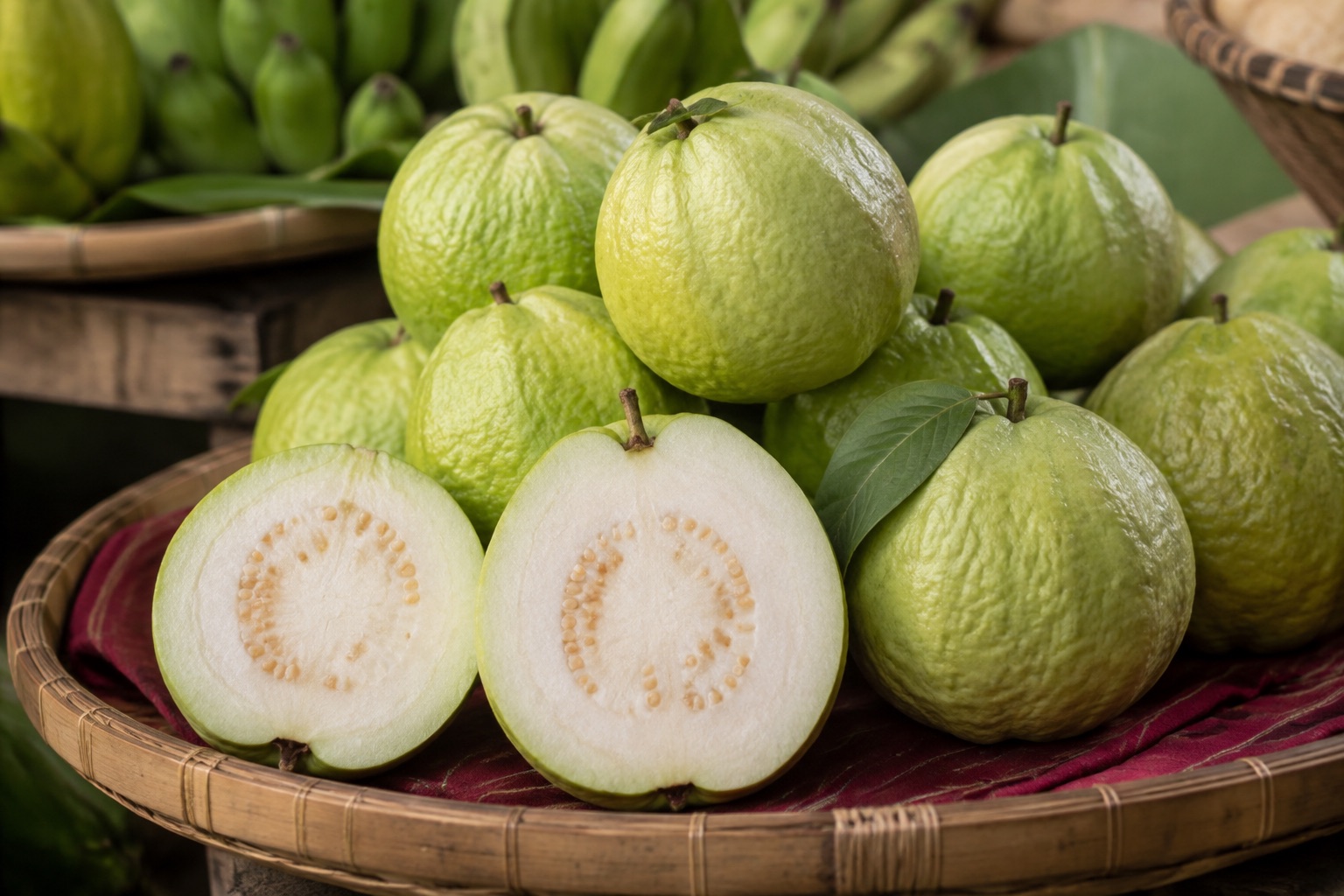
When the conversation is about fruit, ฝรั่ง (fà-ràng) means guava, the green fruit with pale flesh that is common in Thai markets. This is another dictionary meaning of the same word, and context is what decides which one a speaker intends.
So if you are standing at a fruit stall and someone says farang while gesturing at a pile of green fruit, they are almost certainly talking about produce, not about you. The word on the sign, the word in the vendor’s mouth and the word on a menu can all point at the fruit depending on the situation.
We are deliberately not explaining how the fruit got its name. Explanations of the word’s origin vary between sources, and none of them are verified well enough to repeat, so we will stick to what the word means today.
Farang in Compound Words: Western Food and Western Music
In compounds, ฝรั่ง (fà-ràng) signals something Western, as in อาหารฝรั่ง (aahaan farang, Western food) and เพลงฝรั่ง (phleeng farang, Western music). Once you know the pattern, these words become easy to parse on menus, in music apps and in conversation.
- อาหารฝรั่ง (aahaan farang): Western food
- เพลงฝรั่ง (phleeng farang): Western music
These 2 examples are verified lesson vocabulary, and they show the word doing productive work in ordinary Thai. Note the scope here: these are verified lexical examples, not a rule that every item from abroad automatically takes the farang label. Treat the pattern as a recognition tool, not a grammar law.
Broader Thai Words for a Foreigner
Thai also has broader, more general words for a foreigner: คนต่างชาติ (khon tang chat) and ชาวต่างชาติ (chao tang chat). Thai teaching describes both as somewhat formal, and both cover foreigners generally, without pointing at any particular appearance or region.
| Word | Script | Romanization | Typical use |
|---|---|---|---|
| Farang | ฝรั่ง | fà-ràng | Commonly a Westerner perceived as white; everyday speech |
| Khon tang chat | คนต่างชาติ | khon tang chat | A foreigner generally; somewhat formal |
| Chao tang chat | ชาวต่างชาติ | chao tang chat | A foreigner generally; somewhat formal |
If you want a neutral way to refer to foreigners as a group, or you are writing something where a broad term fits better, คนต่างชาติ (khon tang chat) and ชาวต่างชาติ (chao tang chat) are the tools to reach for. For more vocabulary you can use in daily life, browse our guide to Thai words for everyday conversations.
Is Farang Rude? Why Tone and Context Matter
Farang is not automatically an insult; the same word can be neutral everyday speech or feel disrespectful depending on tone and context. Cultural commentary makes the key point: a rude or dismissive tone can make the word feel disrespectful, while an ordinary delivery usually makes it plain description.
That means there is no reliable formula for deciding how any single instance of the word is meant. What you can do is read the situation:
- Delivery: Is the word said flatly as a description, or sharpened with a sneer or a dismissive edge?
- Situation: Is it a vendor describing a customer to a colleague, or someone saying it directly to your face in an argument?
- Pattern: Is this 1 word in an otherwise friendly exchange, or part of repeated hostile commentary?
An honest caveat: nobody can tell you how to feel about a word, and hearing it repeatedly can wear on people regardless of intent. Reading tone and context helps you interpret the situation accurately; it does not obligate you to any particular reaction.
Respectful Ways to Address Someone in Thai
If you are speaking to someone directly and do not know them, Thai teaching recommends using คุณ (khun), the polite word for “you,” rather than calling them farang. This is a sensible default for anyone who wants to sound courteous.
The useful distinction here is between describing someone and addressing someone. Describing a person as a farang when talking about them to a 3rd party is one thing. Speaking directly to a person’s face and using farang as your word for “you” is a different act, and it can come across as reducing someone to a category instead of treating them as an individual.
Here is an original instructional example. Imagine you are at a hotel front desk and want to ask another guest a question politely. The respectful habit is to open with khun before their name or on its own, the way English speakers soften requests with “sir” or “ma’am,” rather than opening with a label.
A final piece of practical advice: if you prefer people to use your name, saying it and using it yourself is a reasonable way to set that pattern early in a conversation. People follow the lead you give them, and giving your name is friendlier than waiting for a label to appear.

Learn Everyday Thai Words the Practical Way
You can now read farang in context, say ฝรั่ง as fà-ràng, recognize the guava meaning, and choose neutral words like คนต่างชาติ (khon tang chat) when you need them. That is a genuinely useful small toolkit for your first weeks in Thailand.
If you want to keep building vocabulary like this with structured lessons for real situations in Bangkok, explore our Thai language course. And for broader background on the country and its culture, our page of facts about Thailand is a good next read.
Frequently Asked Questions
Does farang mean every foreigner in Thailand?
No, farang commonly refers to a Westerner perceived as white, not to every foreign national. If you need a broad term for foreigners generally, Thai uses คนต่างชาติ (khon tang chat) and ชาวต่างชาติ (chao tang chat), which Thai teaching describes as somewhat formal.
Should I use farang to describe myself?
There is no single required habit, and the practical advice is simple: introduce yourself by name rather than by label, and let people follow your lead. When you need neutral language, คนต่างชาติ (khon tang chat) and ชาวต่างชาติ (chao tang chat) are the broader, more formal terms.
What should I think when someone calls me farang?
A single word does not prove intent. Cultural commentary explains that a rude or dismissive tone can make the word feel disrespectful, while an ordinary delivery usually makes it neutral description, so read the tone and the situation before drawing a conclusion.