Best Floating Markets in Bangkok: Your Ultimate Guide
Compare 8 floating markets in and near Bangkok, including atmosphere, travel time, planning cautions, useful Thai phrases and checks before you travel.
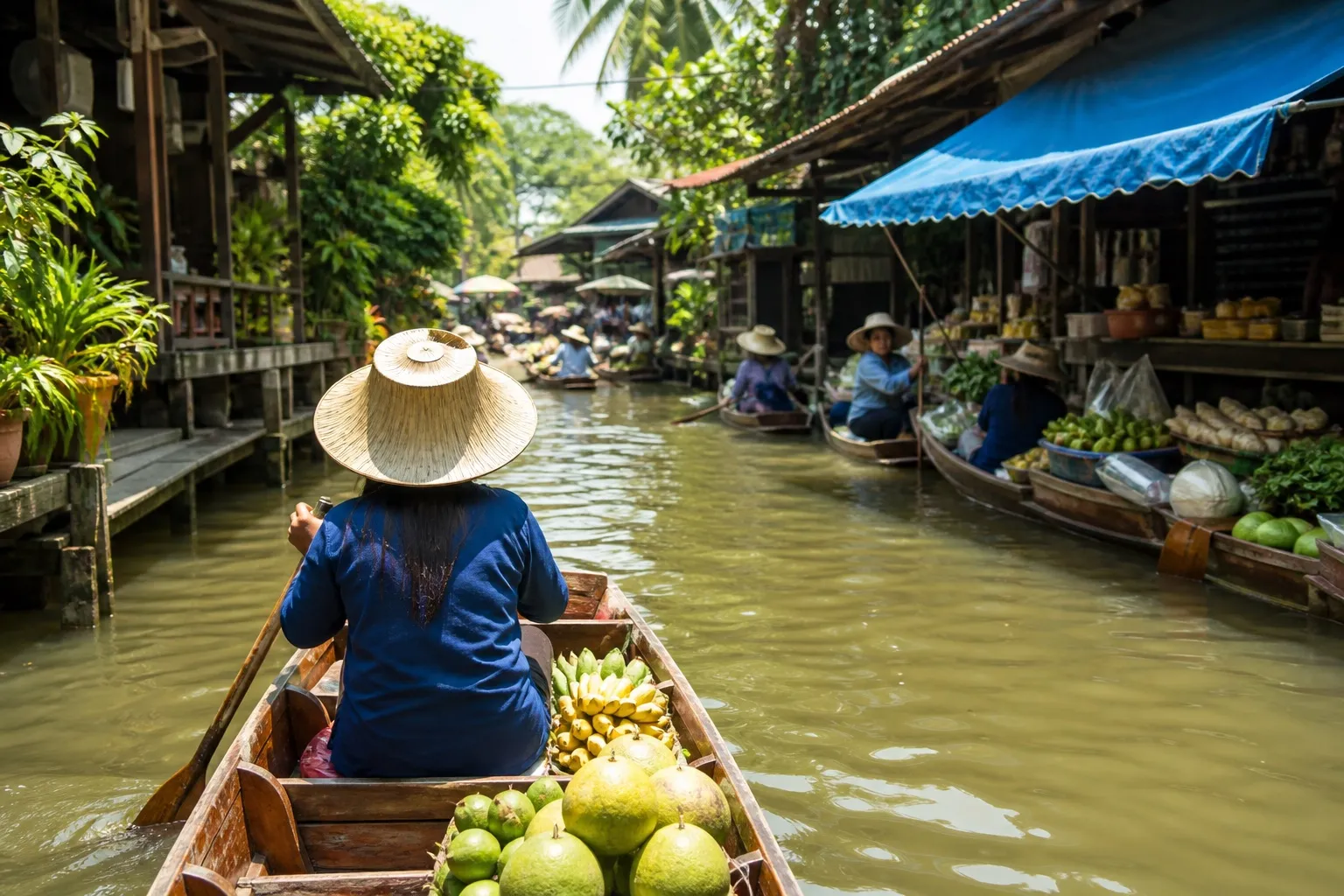
Bangkok’s floating markets are among the most photographed experiences in Thailand, but they are also among the most misunderstood. Some markets sit inside Bangkok or just at its edge and are easy to reach in a morning. Others are 80 to 110 km from the city and require a half day or full day trip. The boats, the food, the crowds, and the prices all change depending on which market you choose. This guide explains the real differences between the best floating markets in and near Bangkok, what to expect at each one, how to visit without causing harm, and which Thai phrases will actually help you on the water.
Before you plan around any specific opening time or boat price, check current conditions. Floating markets in Thailand change their hours, boat routes, and vendor numbers depending on the season, public holidays, and post-pandemic recovery. Official tourism pages and recent visitor reports are more reliable than older blog posts.
What “floating market” really means in Bangkok
A floating market in Thailand is not one single thing. Some markets still function as working food markets where paddlers sell fruit, vegetables, and cooked dishes from small boats. Others are now primarily tourist attractions where boats cluster around a wooden walkway and vendors sell souvenirs, hats, and grilled snacks from the bank.
In Bangkok itself, there is no large traditional floating market left in the old sense. The city’s canals were filled in or built over during the 20th century, and most canal side trading moved to land. What remains are smaller canal markets, boat noodle vendors, and weekend markets with a floating element. The famous markets that appear in most travel guides are outside Bangkok in neighbouring provinces such as Ratchaburi, Samut Songkhram, and Nakhon Pathom.
That distinction matters. If you want a quick canal experience without leaving the city, you have options. If you want the classic wooden boats packed with mangoes and steaming noodles, you need to travel further.
Floating markets inside or very close to Bangkok

These markets are reachable by public transport, taxi, or a short Grab ride. They suit visitors with limited time in Bangkok, but they are smaller and more tourist oriented than the markets further out.
Taling Chan Floating Market
Taling Chan is the most practical floating market for someone staying in central Bangkok. It sits in Taling Chan district on the western side of the city, about 12 to 15 km from Siam. The market is open on weekends and public holidays, usually from morning until mid afternoon, but exact hours change.
The market is built around a canal side plaza. A small number of boats moor along the edge and sell grilled prawns, noodles, som tam, and fruit. Most of the market is on land, with covered seating areas and a few shops. The boat vendors are real, but the scale is modest. You can eat on a mat by the water and watch long tail boats pass.
Taling Chan also offers canal tours from a pier next to the market. These tours go through the khlongs of Thonburi and sometimes stop at a nearby orchid farm or temple. Prices depend on the route and the number of passengers, so ask at the pier on the day.
Getting there is straightforward. You can take the BTS to Bang Wa station and then a taxi or motorcycle taxi, or take a bus along Phran Nok or Phutthamonthon Sai 1 Road. A taxi from central Bangkok takes 30 to 45 minutes depending on traffic.
Khlong Lat Mayom Floating Market
Khlong Lat Mayom is about 5 km south of Taling Chan and has a more local feel on weekend mornings. It is smaller, greener, and less polished. The market sits beside a narrow canal in Bang Khun Thian district. Boats sell food from the water, but again, most stalls are on land.
The food is the main reason to visit. You will find grilled fish, boat noodles, coconut pancakes, and fresh fruit at lower prices than at tourist markets in the city centre. There is also a small boat trip along the canal, often stopping at a lotus pond or a local temple.
Khlong Lat Mayom is harder to reach by public transport than Taling Chan. The nearest BTS station is Bang Wa, but you still need a taxi or songthaew from there. Most visitors come by car or join a half day tour that combines both Taling Chan and Khlong Lat Mayom.
Bang Nam Phueng Floating Market
Bang Nam Phueng is not a floating market in the traditional sense. It is a weekend market on a bend of the Chao Phraya River in Phra Pradaeng, Samut Prakan, sometimes called Bangkok’s “green lung.” A few vendors sell from small boats along the water, but the market is mostly on land under trees.
The appeal is the setting. Phra Pradaeng is a low rise, heavily planted area with cycling paths and quiet lanes. The market sells local food, plants, and handmade goods. It is popular with Thai families and cyclists.
To get there, you cross the river by ferry from Bang Na or take a taxi to the Phra Pradaeng side. The market is open on weekends, roughly from morning to late afternoon. Combine it with a bicycle rental if you want a break from Bangkok traffic.
Floating markets requiring a longer trip from Bangkok

These are the markets that match the postcard image. They are 1.5 to 2 hours from central Bangkok by road. You can visit independently by taxi or minivan, or join a guided tour. Start early. Most are busiest and most photogenic before 9:00.
Damnoen Saduak Floating Market
Damnoen Saduak in Ratchaburi province is the most famous floating market in Thailand. It is about 100 km southwest of Bangkok. The market was built around a straight canal dug in the 1860s, and it became a major tourist attraction in the 1970s.
The main canal and its side canals fill with wooden boats in the morning. Many boats sell fruit, coconut pancakes, and souvenirs. Other boats carry tourists on short paddling routes through the narrow waterways. The market is colourful and busy, but it is also heavily commercialised. Prices are higher than at local markets, and some boat operators ask for inflated fares.
The experience depends on when you arrive. Large tour groups start arriving around 8:30 or 9:00. If you reach the market at 7:00 or 7:30, you will see more actual trading and fewer tour boats. The market is open every day, but the busiest trading happens in the morning.
Damnoen Saduak is easy to combine with a visit to Maeklong Railway Market or the salt farms of Samut Songkhram. A private taxi from Bangkok costs more than a tour seat but gives you control over timing.
Amphawa Floating Market
Amphawa is about 90 km southwest of Bangkok in Samut Songkhram province. It is different from Damnoen Saduak in one important way: it is a walking market along the canal, not a boat market in the middle of the water. Food vendors set up on the canal side, and customers sit on steps or at small tables by the water. A few boats sell seafood and sweets from the canal, but the market is primarily on land.
Amphawa is most active on Friday, Saturday, and Sunday evenings. The market starts in the afternoon and becomes crowded after sunset. Grilled river prawns, squid, and boats selling noodles are common. The atmosphere is lively and more Thai than Damnoen Saduak, with many domestic visitors.
After dark, you can take a boat trip to see fireflies along the Mae Klong River. The firefly tours are seasonal and weather dependent. Not every boat runs every night, so ask at the pier before paying.
Amphawa is best combined with an overnight stay in Samut Songkhram or a late return to Bangkok. The drive back takes about 1.5 to 2 hours. If you want to see Amphawa without the evening crowds, go on a Saturday afternoon before 16:00.
Bang Noi Floating Market
Bang Noi is a much smaller market in Samut Songkhram, about 10 km from Amphawa. It is open on weekends and some holidays. The market is set along a narrow canal with old wooden houses on both sides. A handful of boats sell food, and local families run small stalls from their front steps.
Bang Noi feels closer to a living canal community than a tourist attraction. There is no large boat tour operation. You walk along the canal path, buy food, and sit on a bench by the water. Some visitors combine Bang Noi with Amphawa in one afternoon, since they are close to each other.
The market is not always open, and vendor numbers vary. If you travel there without checking, you may find only a few stalls. Ask your hotel or a local tour desk before making the trip.
Tha Kha Floating Market
Tha Kha is about 15 km from Amphawa and is the quietest of the well known floating markets near Bangkok. It follows the lunar calendar. The main market days are the 2nd, 7th, and 12th days of the waxing and waning moon, which means the dates shift every month. Some vendors also appear on weekends, but the lunar days are the reliable ones.
The market is small and local. Paddlers sell vegetables, fruit, and cooked food from boats along a shaded canal. There are few souvenir stalls. Most customers are Thai. The atmosphere is calm, especially in the early morning.
Tha Kha is the best choice if you want to see a floating market that still feels like a market rather than a theme park. The trade off is that you need to check the lunar calendar and arrange transport carefully. It is not on the standard tour bus route.
Bangkok markets with a floating element
Some visitors search for “floating markets Bangkok” and end up at places that are not floating markets at all. That is not necessarily a bad thing, but it helps to know what you are booking.
Asiatique and the Chao Phraya piers
Asiatique is a riverside shopping and dining complex, not a floating market. There are no vendors in boats. Some dinner cruises and shuttle boats dock there, which may explain the confusion. It is a pleasant evening destination but does not provide a floating market experience.
Iconsiam indoor floating market
Iconsiam, a large shopping mall on the Chao Phraya River, has an indoor zone designed to look like a floating market. There are wooden boats, canal style decor, and food stalls. It is air conditioned, clean, and open every day. Some boats are fixed displays, and some sell food from the side.
This is not a real floating market, but it is useful for visitors who cannot travel outside Bangkok or who want a comfortable introduction to Thai market food. Prices are higher than at street markets, and the experience is controlled. If you understand that before you go, it can be an enjoyable stop.
Responsible tourism at floating markets
Floating markets are not museum exhibits. People live, trade, and raise families along these canals. A few simple choices make a real difference.
Pay fair prices without haggling aggressively
Boat fares and food prices at tourist markets are often quoted higher for foreign visitors. That does not mean you should accept any number, but aggressive haggling over 20 or 30 baht can be humiliating for a vendor who earns little. Ask the price first, compare with one other boat operator if possible, and walk away if it feels unreasonable. A calm “phaeng pai” (too expensive) works better than arguing.
Avoid blocking the waterways
The canals are working spaces. If you are on a boat, keep your hands inside and do not stand up suddenly. If you are on a walkway, do not lean over the water to take photos in a way that blocks paddlers. Small boats need room to turn.
Buy food you will actually eat
Food waste is a problem at busy markets. Buy one dish at a time, finish it, and then try something else. Vendors appreciate customers who return for a second item more than customers who take photos and leave half eaten plates behind.
Ask before photographing people
A floating market is full of good photos, but not every vendor wants a camera pointed at their face. A smile and a gesture toward your camera is enough. If someone shakes their head or looks away, move on.
Support markets that support the community
Markets like Tha Kha, Bang Noi, and Khlong Lat Mayom put money directly into local hands. When you buy from a paddler at one of these smaller markets, you are supporting a canal economy that has struggled in recent decades. That is a more meaningful souvenir than a mass produced magnet.
Useful Thai phrases for floating markets

Most vendors at tourist markets speak some English, but a few Thai phrases change the tone of the interaction. Thai is a tonal language, so the transliteration below is only a rough guide. Listen to how locals say the words and repeat them as closely as you can.
| English | Thai script | Transliteration |
|---|---|---|
| How much is this? | อันนี้เท่าไหร่ | an nii thao rai |
| Too expensive | แพงไป | phaeng pai |
| Can you reduce the price? | ลดได้ไหม | lot dai mai |
| Not spicy, please | ไม่เผ็ด | mai phet |
| A little spicy | เผ็ดน้อย | phet noi |
| Delicious | อร่อย | a roi |
| Thank you | ขอบคุณ | khawp khun |
| No sugar, please | ไม่หวาน | mai waan |
| Where is the boat pier? | ท่าเรืออยู่ที่ไหน | thaa ruea yuu thii nai |
| I would like one | เอาหนึ่ง | ao nueng |
The phrase “ao nueng” (I would like one) is useful when pointing at food. “Mai phet” (not spicy) is essential if you cannot handle strong chilli. “Lot dai mai” (can you reduce the price) is polite enough for a market setting if said with a smile.
How to choose the right floating market for your trip
The best market depends on your time, your tolerance for crowds, and what you want from the experience.
If you have only a morning in Bangkok
Choose Taling Chan or Khlong Lat Mayom. Both are inside Bangkok or just at its edge. You can visit on a weekend morning and be back in the city by early afternoon. The boat scenes are smaller, but the food is good and the travel time is short.
If you want the classic photo
Choose Damnoen Saduak, but go early. Arrive by 7:30 if you can. The market is commercialised, but the sight of wooden boats packed into a narrow canal is still striking. Accept that you will share it with other tourists.
If you want a Thai evening atmosphere
Choose Amphawa on a Friday, Saturday, or Sunday evening. Walk the canal side, eat grilled seafood, and stay for the firefly boat trip if it is running. Amphawa is more about the atmosphere than the boats.
If you want a quiet, local market
Choose Tha Kha or Bang Noi. Both require more planning and are not guaranteed to be busy. The reward is a slower, more human scale experience. Check the lunar calendar for Tha Kha and confirm opening days before you travel.
If you cannot leave central Bangkok
Iconsiam’s indoor market is a fallback, not a substitute. It is comfortable and easy, but it is a themed food hall. Use it as an introduction, not as the main event.
Transport and opening details: why you must check before travelling
Floating market information changes often. A market that opened at 7:00 in 2019 may open at 8:00 now. A boat pier that ran hourly trips before the pandemic may run fewer trips or none on weekdays. Road works, flooding, and public holidays also affect access.
Here is what to check before you go:
- Opening days and hours. Search for the market name plus the current month and year. Look for recent visitor photos with timestamps or comments from the last few weeks.
- Boat trip availability. Some markets have boat tours only at certain times or only when enough passengers arrive. If a boat trip is essential for you, confirm it is running before you pay for transport.
- Transport routes. Public bus and songthaew routes in Bangkok and Samut Songkhram change. A route that existed in a 2022 blog post may no longer run. Check with your hotel or a current map app.
- Weather. Floating markets are outdoor places. Heavy rain reduces vendor numbers and makes canal paths slippery. Check the forecast and the current destination notice before leaving. The Tourism Authority of Thailand’s market guide is a useful starting point, but the venue’s current information takes priority.
- Tour inclusions. If you book a tour, ask exactly which market you will visit, how long you will stay, and whether the boat ride is included. Some tours stop at a “floating market” for 30 minutes and spend the rest of the day at a gem shop or a coconut farm.
A little checking prevents the disappointment of arriving at a closed market or paying for a boat that is not running.
What to eat at Bangkok’s floating markets
The food is the most reliable part of the floating market experience. Even at tourist heavy markets, the cooked food is often excellent.
Boat noodles
Small bowls of pork or beef noodles, served from boats at several markets. The portions are small by design, so you can eat two or three bowls. At Amphawa and Damnoen Saduak, boat noodles are common.
Grilled river prawns
Large freshwater prawns grilled over charcoal, served with a spicy seafood sauce. Amphawa is known for these. Prices are higher than for other dishes, so ask the price before ordering.
Coconut pancakes
Small round pancakes made with coconut milk, either sweet or savoury. They are sold at nearly every floating market and are easy to eat while walking.
Som tam
Green papaya salad, pounded to order. Tell the vendor “mai phet” if you want it mild, or “phet noi” for a little chilli. Som tam at canal markets is often sharper and more pungent than restaurant versions.
Mango sticky rice
Sweet mango with sticky rice and coconut cream. It is a dessert, but many people eat it as a mid morning snack. The best versions use ripe nam dok mai mangoes.
Grilled fish stuffed with herbs
Whole fish packed with lemongrass and lime leaves, grilled slowly. This is more common at Khlong Lat Mayom and Amphawa than at Damnoen Saduak.
A note on learning Thai before your trip
You do not need to speak Thai to visit a floating market, but even 10 or 15 phrases make the experience easier. You can order food more accurately, ask for a fair price without tension, and understand when a vendor tells you a boat is full or a path is closed.
If you are staying in Bangkok for more than a few weeks, a structured Thai course helps more than phrasebook memorisation. Schools in Bangkok offer short courses focused on daily conversation, including market and food vocabulary. Learning to hear the tones correctly takes practice, but it pays off the first time you order “phet noi” and get exactly the spice level you wanted. See the school’s Thai language courses if you want guided practice before travelling.
FAQ
Which floating market is closest to central Bangkok?
Taling Chan Floating Market is the closest well known option. It is about 12 to 15 km from Siam and reachable by taxi in 30 to 45 minutes, depending on traffic. It is open on weekends and public holidays.
Is Damnoen Saduak worth the long trip?
It depends on what you want. Damnoen Saduak is the largest and most photogenic floating market near Bangkok, but it is also the most tourist heavy. If you go early, before 8:00, the experience is better. If you dislike crowds and souvenir stalls, choose Tha Kha or Amphawa instead.
Are floating markets open every day?
No. Most floating markets near Bangkok have limited days. Taling Chan and Khlong Lat Mayom are weekend markets. Amphawa is mainly Friday to Sunday. Tha Kha follows the lunar calendar. Damnoen Saduak is open daily, but the morning is the active time. Always check current opening days before travelling.
Do I need to book a tour to visit a floating market?
No. You can visit Taling Chan, Khlong Lat Mayom, Amphawa, and Damnoen Saduak independently by taxi, minivan, or public transport. A tour is useful if you want to combine several stops or avoid transport planning, but it is not required.
How much does a boat ride cost at a floating market?
Boat ride prices vary by market, route length, and whether you share the boat. At Damnoen Saduak, a short paddling boat ride may cost a few hundred baht per person, while a longer motorised route costs more. At smaller markets, prices are lower. Always confirm the price and the route before boarding.
What is the best time of day to visit a floating market?
Early morning is best for most markets. Vendors are active, the light is good, and the crowds are smaller. For Amphawa, the market is an evening experience, so late afternoon to early evening is the right time. Avoid midday at outdoor markets, when the heat is strongest and some vendors take a break.